The Categories of Clinical AI
Generative, predictive, rule-based, conversational and agentic: why the single word AI hides what clinicians most need, and a simple lens to tell them apart.
Respocare Connect AI Team — Respocare (PTY) Ltd · Reg. 2018/411829/07 · Practice No. 9990900010775614. Licensed healthcare practice operating since 2018.
· 7 min read
AI Is Not One Thing: The Categories of Clinical AI
Why the single word "AI" hides the distinctions a clinician most needs, and a simple lens for telling the categories apart.
The problem with a single word
When a product says it "uses AI", a clinician has learned almost nothing. The word names a bucket, not a thing. Inside it sit categories that behave so differently from one another that treating them as one is the first mistake — and, in a clinical setting, a consequential one.
A tool that transcribes a consultation, a model that predicts readmission risk, a script that routes a referral, a chatbot that answers a question, and a system that reasons across a patient's record are all called "AI". They fail in different ways, they carry different risks, and they warrant different trust. The generic term erases exactly the information a clinician needs to decide whether to rely on any of them.
Five things people call "AI"
Five distinct categories travel under the same word. Generative models produce text from a prompt. Predictive models score a case against patterns learned in training. Rule-based automation follows fixed logic and often does not learn at all. A conversational assistant answers in natural language, plausibly, whether or not it is grounded in anything. And an agentic system retrieves the relevant record, reasons across it, and acts within defined limits — while refusing and escalating when it should.
| Called "AI" as… | What it actually is | What it does | What to watch |
|---|---|---|---|
| "AI writes the note" | Generative model | Produces text from a prompt | Not bound to the record — can read fluently and still be wrong |
| "AI flags the risk" | Predictive model / classifier | Scores a case against training patterns | A score, not reasoning; inherits the training data's blind spots |
| "AI runs the workflow" | Rule-based automation | Follows fixed logic | Often does not learn; breaks quietly when reality leaves the rules |
| "AI answers questions" | Conversational assistant (LLM) | Replies in natural language | Plausible whether or not it is grounded; confident when it should not be |
| "AI works the record" | Agentic system | Retrieves, reasons, acts within limits, refuses, escalates | The output is still a draft — the clinician decides |
Five categories that travel under the single word AI.
Why the conflation is a clinical risk
Collapsing these into one word does two kinds of harm.
First, it smuggles in autonomy. "AI decides", "AI diagnoses", "AI flags the problem" — the phrasing implies the software is making the call. A responsible clinical system is built to do the opposite: to draft and to surface, and to leave the decision with the clinician. When the generic term implies autonomy the system does not have, it oversells what is safe and misrepresents what is being claimed.
Second, it imports the wrong reputation. A grounded reasoning system gets judged by the failures of an ungrounded chatbot, because both are "AI". The hallucination that makes a consumer chatbot untrustworthy is a property of one category used in one way — not a law of the whole field. Lumping them together means the tools that took the trouble to be safe are tarred with the failures of the tools that did not.
The practical consequence is the one that matters at the bedside: each category fails differently, and a clinician cannot manage a risk they cannot name. Knowing which category a tool belongs to is the first step in knowing how it will let you down.
The distinction that actually matters
The useful question is not how capable a system is. It is what the system is accountable to, and what it will refuse to do.
Capability is a poor guide to clinical fitness, because a model that always produces an answer will always produce something — including when it should not. The better guide is behaviour: does the system ground its output in the patient's record, does it act only within defined limits, and does it hand the decision back to the clinician. A system built to retrieve, reason, act, refuse and escalate is a different kind of software from one built only to generate, regardless of which is more impressive in a demonstration.
This is why the governing sentence is worth stating plainly: the AI drafts, the record verifies, the clinician decides. It is a description of accountability, not of capability.
How to read any clinical AI claim
Three questions separate a clinical tool from a liability, whatever the marketing calls it.
Is it grounded in the patient's record? If the output comes from a general model rather than this patient's history, it is generic content, however fluent.
Does it act only within defined limits? If it can take actions without bounds, the failure mode is unbounded automation, not assistance.
Does it refuse and escalate to the clinician? If it will not decline when it lacks grounding, and will not hand judgement back to a human, it is not safe to trust unattended.
A tool that answers yes to all three is behaving as an agentic clinical system should. A tool that answers no to any of them may still be useful — but the clinician now knows exactly where the caution lies.
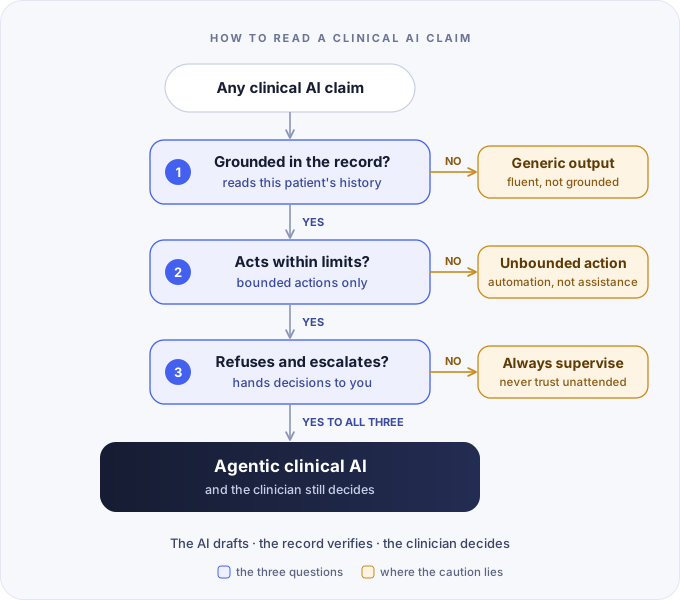
Three questions to put to any clinical AI claim; each "no" marks where the caution lies.
Where agentic clinical AI sits
Agentic clinical AI is the category built to answer yes to all three questions. It is not a cleverer generative model and it is not a chatbot with a medical vocabulary. It is a system designed to work across the living record, to draft within limits as a set of instruments, and to defer every clinical decision to the practitioner.
It remains a clinical assistant and tool — not a medical device, not diagnostic, and not a substitute for clinical judgement. Every output requires independent review by a qualified clinician. That is the point of the distinction: the categories are not marketing labels, they are a guide to how much of the work still belongs to you. All of the deciding does.
Frequently asked questions
Is all AI in healthcare the same thing?
No. The single word "AI" covers several distinct categories — generative models, predictive models, rule-based automation, conversational assistants, and agentic systems. They behave differently, fail differently, and warrant different levels of trust, so treating them as one thing is misleading in a clinical setting.
What is the difference between generative AI and agentic AI in medicine?
Generative AI produces content from a prompt and has no obligation to anything beyond it. Agentic AI is built to retrieve the patient's record, reason across it, act within defined limits, refuse when it lacks grounding, and escalate decisions to the clinician. Generative production can be one part of an agentic system, but the two are not the same.
Does "AI" mean the software makes clinical decisions?
No. A responsible clinical AI system drafts and verifies against the record; the clinician makes every clinical decision. Language that implies the software decides or diagnoses overstates what such systems are built to do.
What questions should a clinician ask about a clinical AI tool?
Three questions separate a clinical tool from a liability: is its output grounded in the patient's record, does it act only within defined limits, and does it refuse and escalate to the clinician when appropriate. The answers reveal the category the tool belongs to and where its risks lie.
Why does the type of AI matter for patient safety?
Because each category fails in a different way, and a clinician cannot manage a risk they cannot name. Knowing whether a tool is a generative model, a predictive model, automation, a chatbot, or an agentic system is the first step in knowing how far it can be trusted and where independent review is essential.
Built by Respocare (PTY) Ltd — a licensed South African healthcare practice operating since 2018.