Agentic Clinical AI: A Complete Guide
What agentic clinical AI is, how it differs from an AI scribe, and the five behaviours — retrieves, reasons, acts, refuses, escalates — that govern its safety.
Respocare Connect AI Team — Respocare (PTY) Ltd · Reg. 2018/411829/07 · Practice No. 9990900010775614. Licensed healthcare practice operating since 2018.
· 9 min read
Agentic Clinical AI: The Complete Guide to AI That Reasons Across the Patient Record
A reference for practising clinicians on what "agentic" means in a clinical setting, how it differs from a generative tool or an AI scribe, and the behaviours that determine whether it is safe to use.
What agentic clinical AI is
Agentic clinical AI is software that does not simply generate text on request. It retrieves the relevant clinical record, reasons across it, acts within defined limits, refuses when it should not proceed, and escalates to the clinician when a decision belongs to a human.
The distinction from a generative tool is behavioural, not cosmetic. A generative model answers the prompt in front of it. An agentic clinical system is built to work across a patient's longitudinal record — the letters, results, medication history and prior encounters — and to behave differently depending on what it finds there. It is designed to know when it does not have enough information, and to say so.
One sentence governs how such a system should operate: the AI drafts, the record verifies, the clinician decides.
Agentic, generative, and the AI scribe: a clarification
These three terms are often used interchangeably. They are not the same thing — and they are only three of the categories of clinical AI.
Generative AI produces content — text, a summary, a draft — from a single instruction. It has no obligation to be consistent with anything beyond the prompt.
An AI medical scribe is a specific application of that technology. It ingests an encounter and drafts a clinical note. A scribe is useful, but its job ends at the note.
Agentic clinical AI is broader. It is engineered to reason across the whole record and to take bounded actions on the basis of that reasoning — drafting a report, surfacing a checklist, flagging an omission — while deferring every clinical decision to the practitioner. Where a scribe transcribes, an agentic system is built to reconcile: to notice that a stated allergy contradicts a proposed action, or that a result has moved outside its reference range since the last visit.
An AI scribe can be one instrument within an agentic platform. It is not a synonym for one.
| Dimension | Generative AI | AI medical scribe | Agentic clinical AI |
|---|---|---|---|
| Core job | Produce content from a prompt | Draft a note from a post-encounter dictation | Reason across the record and act within limits |
| Scope of context | The prompt only | The current encounter | The patient's longitudinal living record |
| Source of truth | The model | The encounter dictation | The patient record, verified each time |
| Takes bounded action | No | Drafts a note | Drafts notes, reports and checklists |
| Refuses when ungrounded | No | Not by design | Yes — a core behaviour |
| Escalates to the clinician | No | No | Yes — decisions defer to the clinician |
| Handles contradictions | No | No | Flags them (e.g. a stated allergy against a proposed action) |
| Output status | Final text | Draft note | Draft for clinician review |
| Clinical decision-making | None | None | None — the clinician decides |
How agentic clinical AI differs from a generative tool and an AI scribe.
The five behaviours of an agentic clinical system
The value of an agentic system is not in what it can produce. It is in how it is constrained. Five behaviours define whether a clinical agent is trustworthy.
Retrieves. It locates the relevant information within the patient's record before it acts, rather than answering from a general model. Identity is enforced first: the system is built so that a patient and clinician are established before any operation runs, so that information is never drawn from the wrong record.
Reasons. It works across the longitudinal record, not a single document — comparing an entry against the history, and treating the record as the source of truth rather than its own prior output.
Acts. Within defined limits, it drafts — a note, a report in one of several standard formats, a round checklist. Every action produces a draft for review, never a final clinical document.
Refuses. When it lacks sufficient grounding, or when a request falls outside what it should do, it declines. Refusal is not a failure state. It is the highest expression of clinical safety: a system that will not guess is safer than one that always answers.
Escalates. When a matter requires clinical judgement, it hands the matter to the clinician rather than resolving it silently. The system understands and drafts; the clinician decides. That division is deliberate, and it does not move.
These five behaviours are the difference between a clinical tool and a liability. A model that only generates will always produce something. A model built to retrieve, reason, act, refuse and escalate is built to produce the right thing, or nothing.
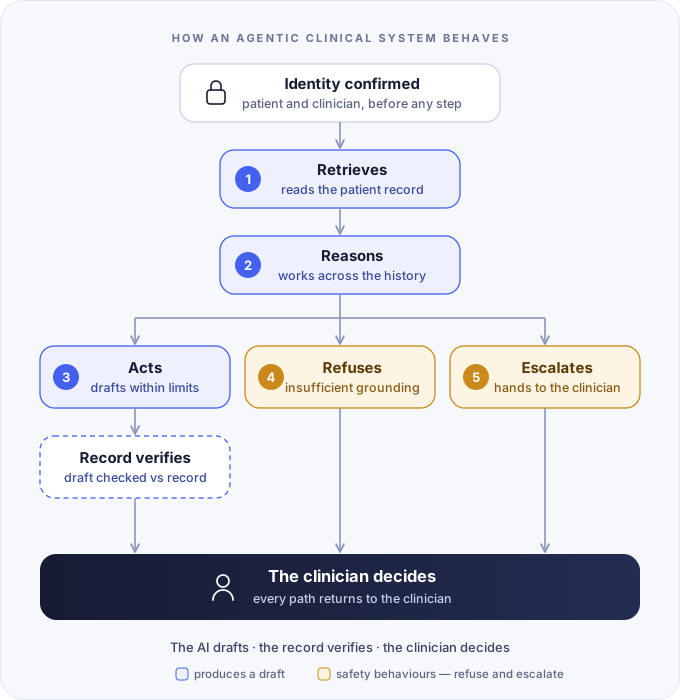
The five behaviours of an agentic clinical system, with identity enforced first and every path returning to the clinician.
Why refusal and escalation matter more than capability
The prevailing narrative around clinical AI emphasises capability — what the model can do. For a clinician, the more important question is what the model will not do.
A system that hallucinates a plausible but wrong medication, or invents a result to complete a summary, is not a productivity tool. It is a documentation risk and a patient-safety risk. The engineering that prevents this is not additional capability. It is restraint: grounding every statement in the record, refusing to proceed without it, and escalating anything that belongs to a human.
This is why capability benchmarks alone are a poor guide to clinical fitness. The relevant standard is whether the system behaves safely at its worst, not impressively at its best.
The living record: reasoning across time, not turns
A conversational assistant treats each exchange as a fresh turn. A clinical agent cannot. Clinical reasoning is longitudinal — a value means little without the trajectory behind it.
An agentic clinical platform is built around a living record: the patient's history held as the reference against which every draft is checked. When the system drafts, it verifies against that record rather than against its own earlier output. The effect is that a rising result, a resolved diagnosis or a confirmed allergy is carried forward and reasoned about, not forgotten between interactions.
Governance, scope and the line the clinician holds
Agentic clinical AI is a clinical assistant and a tool. It is not a medical device, it is not diagnostic, and it is not a substitute for clinical judgement. Every output it produces requires independent review by a qualified clinician before it is relied upon.
That scope is not a caveat added at the end. It is the design premise. The system is built to draft and to verify; the clinician verifies and decides. Data governance follows the same principle — HIPAA-aligned and POPIA-compliant handling of clinical information, with access bound to the correct clinician and patient before any operation begins.
The claims made for such a system should be read carefully. There is a difference between a system built to deliver a clinical promise — an architecture question, answerable now — and output proven to deliver it, which is a matter of ongoing clinical validation. Both can be true at once. Conflating them is the most common way clinical AI is oversold. A responsible platform states plainly which it is claiming.
What this looks like in practice
An agentic clinical platform is best understood as a set of instruments a clinician can reach for, each producing a draft for review:
- Document intelligence — reading and structuring uploaded clinical documents so they can be reasoned about.
- An agentic clinical assistant — answering questions across the record, within the five behaviours above.
- A medical AI scribe — drafting a clinical note from post-encounter dictation.
- Clinical report generation — producing a structured report in one of several standard formats.
- A round checklist — surfacing what a clinical review should cover for a given patient.
Each instrument drafts. The record verifies. The clinician decides. That sentence is the whole of the design.
Frequently asked questions
What is agentic clinical AI?
Agentic clinical AI is software that retrieves the relevant patient record, reasons across it, acts within defined limits, refuses when it lacks sufficient grounding, and escalates decisions to the clinician. It differs from generative AI in that it is built to work across a patient's longitudinal record rather than a single prompt, and to defer every clinical decision to the practitioner.
How is agentic clinical AI different from an AI medical scribe?
An AI medical scribe drafts a clinical note from an encounter. Agentic clinical AI is broader: it reasons across the entire record and can take bounded actions such as drafting reports or surfacing checklists, while flagging contradictions and deferring clinical decisions to the clinician. A scribe can be one instrument within an agentic platform, but the two are not the same.
Is agentic clinical AI a medical device?
No. Agentic clinical AI of this kind is a clinical assistant and tool, not a medical device and not diagnostic. It produces drafts that require independent review by a qualified clinician before they are relied upon.
Why does refusal matter in clinical AI?
Refusal is a safety behaviour. A system that declines to answer when it lacks sufficient grounding in the record is safer than one that always produces a response, because it does not fill gaps with plausible but unverified content. In clinical use, a system's willingness to refuse and escalate is a better guide to its safety than its raw capability.
Does agentic clinical AI make clinical decisions?
No. The system drafts and verifies against the record; the clinician makes every clinical decision. This division is a fixed design principle, not a temporary limitation.
Respocare Connect AI is a service line of Respocare (Pty) Ltd, a licensed South African healthcare practice.
Built by Respocare (PTY) Ltd — a licensed South African healthcare practice operating since 2018.