Clinical AI and the Doctor
Four peer-reviewed studies on clinical AI: what changes in documentation burden, clinician burnout, attention and reasoning — and what they cannot prove.
Respocare Connect AI Team — Respocare (PTY) Ltd · Reg. 2018/411829/07 · Practice No. 9990900010775614. Licensed healthcare practice operating since 2018.
· 14 min read
Clinical AI and the Doctor: What the Evidence Actually Shows
Artificial intelligence is beginning to change clinicians' working lives. But which improvements have researchers actually measured — and where is the science still catching up with the promise?
There is a quiet contradiction in modern medicine. We have never had more sophisticated clinical tools, more digital records or more information at our fingertips. Yet in many practices, the clinician's day remains divided between caring for the patient and recording the evidence that care took place.
What makes this exhausting is not merely the amount of typing. It is the attention required to reconstruct a consultation, reconcile the history, find the relevant document, write a clinically useful note and keep up with the next patient. Time is finite. Attention is finite. The administrative work surrounding medicine is not.
Artificial intelligence enters this landscape with an attractive promise: to return some of that attention to the work clinicians trained to do. But medicine should not accept promises as evidence. The questions are more exacting. Are documentation tasks measurably lighter? Are clinicians less burned out? Does AI improve reasoning? Does any of that translate into safer, better patient care?
Four peer-reviewed investigations, published between 2024 and 2026, make it possible to begin answering these questions with precision. Their combined message is cautiously encouraging — and considerably more interesting than the marketing narrative.
The relevant question is no longer whether AI can write a clinical note. It is whether clinicians can safely reclaim time and attention without surrendering judgment.
When AI enters the consultation, what happens to burnout?
In October 2025, JAMA Network Open published a multicentre quality-improvement investigation involving 263 ambulatory clinicians across six US healthcare systems. Participants used an ambient AI scribe for 30 days. Rather than examining a demonstration or a model benchmark, the researchers measured clinicians' reported experience in actual practice. [1]
In the adjusted analysis of 184 clinicians, estimated burnout prevalence fell from 51.9% before the intervention to 38.8% after 30 days: an absolute reduction of 13.1 percentage points. That is approximately a 25% relative reduction in the proportion reporting burnout — not proof that AI caused a 25% reduction in burnout severity.
The story does not end with burnout. The investigators also recorded improvements in note-related cognitive workload, after-hours documentation time and the attention clinicians said they were able to give patients. Several of these secondary outcomes were captured on standardized 10-point response scales.
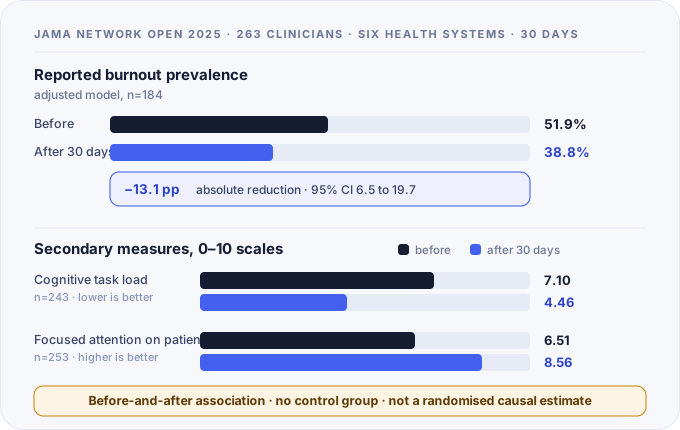
Researchers also found a statistically significant improvement in reported after-hours documentation burden. The study reports a mean decrease of 0.90 on its transformed outcome measure; this should not be extrapolated to a guaranteed time saving for another practice. The before-and-after design limits causal attribution.
What this study does — and does not — establish. It provides real-world evidence of an association between ambient AI scribe use and a better clinician experience over 30 days. It cannot exclude all selection effects, practice changes or other confounding influences. Its short follow-up also cannot show whether improvements persist for a year, nor does it demonstrate improved patient morbidity or mortality.
What happens when researchers combine the documentation studies?
A systematic review and meta-analysis published online in December 2025 and assigned to the 2026 volume of BMC Medical Informatics and Decision Making examined 23 studies of AI tools and clinical documentation burden. Twelve used non-randomized concurrent comparators; eleven used before-and-after comparisons. Fourteen contributed to the main pooled estimate. [2]
The meta-analysis reported a standardized mean difference (SMD) of −0.71 (95% CI −0.93 to −0.49) for documentation workload and related burnout outcomes. That is evidence of a moderate average reduction in measured burden across the pooled studies. It is emphatically not a 71% reduction in documentation time.
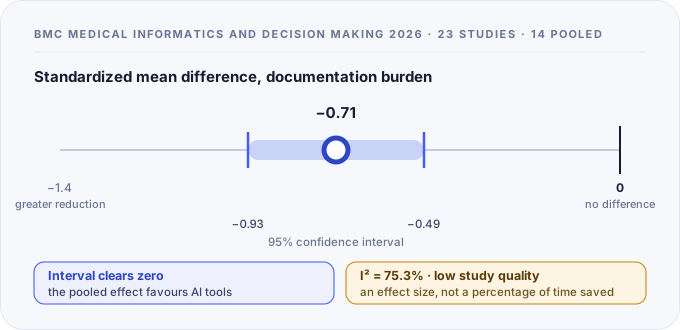
One useful finding was that AI tools still showed reduced documentation time in studies where clinicians reviewed and edited their generated drafts: pooled SMD −0.72 (95% CI −0.99 to −0.45). This matters because medical documentation should not become an unreviewed automatic output. Clinician oversight is not an obstacle to the intended workflow; it is part of the workflow.
The review also found that AI-generated note quality was at least comparable to manually prepared notes in the included evaluations. But comparable average note quality is not proof that every generated detail is correct. A clinically acceptable product needs to handle omissions, contradictions, medication safety, source provenance, difficult cases and erroneous outputs — not merely produce fluent documentation.
Interpreting the strength of evidence. Meta-analysis can provide a broader view than a single study, but it does not automatically repair weaknesses in its inputs. Because the studies differed in populations, tools, endpoints and design, these findings justify cautious optimism, not a universal time-saving or safety claim.
Can AI help doctors reason through clinical management?
Documentation is one part of clinical practice. The more consequential question is whether AI can improve the quality of reasoning about what happens next — the balance of investigations, treatment choices, follow-up decisions and risks.
In a randomized controlled trial published in Nature Medicine in 2025, 92 practicing physicians were assigned to conventional resources alone or GPT-4 plus conventional resources. Each completed five expert-developed simulated cases derived from de-identified clinical encounters. [3]
The physicians with AI assistance scored an average of 6.5 percentage points higher on expert-developed management-reasoning rubrics than the conventional-resources group (95% CI +2.7 to +10.2; p<0.001).
That is clinically interesting. Yet the trial also reported that AI-assisted participants spent an average of about two minutes longer per case (mean difference 119.3 seconds). In other words, the reasoning benefit did not amount to faster completion of the task. Better answers and faster workflows are different outcomes.
Nor did the study demonstrate superior patient outcomes. Simulated clinical scenarios allow reproducible assessment, but they cannot fully capture urgent practice conditions, incomplete notes, liability, evolving illness or the messy constraints of real clinical environments.
A tool that improves performance in a vignette is a promising research result. A tool that improves patient care, safely and consistently, requires more evidence.
Why did another randomized trial find no significant improvement?
In an October 2024 JAMA Network Open trial, 50 physicians were randomized to GPT-4 access plus conventional resources or conventional resources alone to work through diagnostic cases. Median diagnostic-reasoning scores were 76% versus 74%, respectively. The adjusted difference of 2 percentage points was not statistically significant (95% CI −4 to +8; p=0.60). [4]
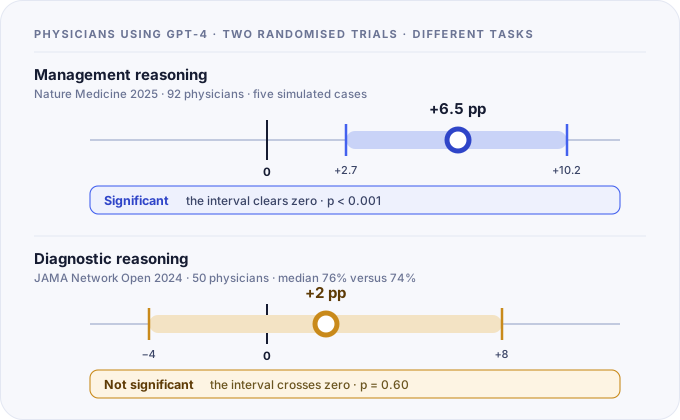
The juxtaposition of the two reasoning trials is not a scientific contradiction. The studies measured different tasks: one examined management decisions, the other diagnostic reasoning; they also differed in scenario structure and study conditions. What they establish together is that model capability cannot be confused with clinician benefit.
A powerful AI system is not necessarily an effective clinical intervention. It has to be embedded into the workflow in a form a doctor can interrogate, verify and use responsibly. The key question is not whether a model can generate an impressive explanation. It is whether the clinician and the tool work better together than the clinician's existing resources.
The evidence, side by side
The most defensible reading is neither uncritical enthusiasm nor dismissal. Benefits have been observed across documentation and clinician experience, and at least one randomized trial demonstrates better management reasoning. But results vary and improvements in hard patient outcomes remain unproven by these four studies.
| Study | Design / sample | Main finding | What it cannot prove |
|---|---|---|---|
| Olson et al., 2025 — JAMA Network Open [1] | Multicentre before–after; 263 clinicians | Adjusted burnout prevalence 51.9% → 38.8% after 30 days | Long-term causation or improved clinical outcomes |
| Zhao et al., 2026 — BMC [2] | Systematic review; 23 studies, 14 pooled | Documentation burden SMD −0.71 (95% CI −0.93 to −0.49) | A universal percent time saving or uniformly high-quality evidence |
| Goh et al., 2025 — Nature Medicine [3] | Randomized trial; 92 physicians | Management reasoning +6.5 percentage points | Better outcomes in real patients or faster performance |
| Goh et al., 2024 — JAMA Network Open [4] | Randomized trial; 50 physicians | Diagnostic scores 76% versus 74%; not significant | A reliable diagnostic advantage from access to AI alone |
Strongest direction of signal. Reduced documentation burden, across several practice-based evaluations.
Promising but conditional. Improved clinician attention, wellbeing and management reasoning, depending on setting and task.
Still to demonstrate. Durable safety, better patient outcomes and generalizability across specialties and health systems.
What should a medical practice actually do with this evidence?
A useful AI implementation should start with a clinical problem, not a feature list. The most practical starting point for many practices is repetitive documentation, where burden is tangible and clinician review can be integrated into an existing sign-off process. From there, more advanced workflows require proportionately stronger safeguards.
- Identify the burden. Measure baseline documentation minutes, after-hours work, cognitive workload and the steps that repeatedly interrupt patient care.
- Choose a controlled, bounded workflow. Begin with an output clinicians can independently verify, such as a structured note draft or a patient-history summary.
- Protect the record. Require appropriate access control, consent and privacy handling, traceability, source review and explicit clinician approval before clinical use.
- Evaluate accuracy and failure modes. Audit omissions, incorrect assertions, medication information, mistaken patient-context retrieval, unsupported conclusions and changes made during review.
- Measure the actual net effect. Compare total workflow time including editing; monitor clinician satisfaction, residual burden and relevant patient-safety signals.
- Expand only when justified. Progress toward longitudinal retrieval and reasoning only after demonstrating safe, reliable operation in the intended clinical setting.
For South African clinicians, appropriate handling of patient data under POPIA is a core requirement. International organisations should similarly assess applicable health-information rules, including GDPR or HIPAA where relevant. Privacy policy language is not a substitute for tested technical controls, contractual obligations and operational governance.
A useful question for every AI vendor: "What does the doctor still need to verify?"
A trustworthy answer should be specific. Which sources were used? Can the draft be audited? Are uncertainties made visible? Can a clinician refuse, correct and approve the output? How are failures detected and investigated?
Clinical AI should make verification easier, not hide the need for it.
The scribe is the beginning. The clinical workflow is the destination.
These studies help explain why AI documentation has been an important entry point. The benefit is concrete: less manual preparation of notes, potentially less cognitive burden and more attention available for patients. But a clinical day does not begin and end with a note.
Clinicians also need to understand what has happened across earlier consultations, letters, laboratory results, imaging, medication changes and follow-up plans. The information may exist, but remain scattered across time and documents. Building systems that can retrieve the right facts, reveal their provenance and acknowledge what is missing is a different and harder problem than transcription.
That is the direction behind the concept of a governed agentic clinical workspace: not merely producing text, but supporting controlled clinical information tasks across the patient journey. Such systems must never be presumed safe or effective because a language model performs well on a benchmark. The system must earn trust through task-specific evaluations, access boundaries, error analysis and clinician oversight.
At Respocare Connect AI, the current public platform describes a Medical AI Scribe for clinician-reviewed documentation, a Clinical AI Assistant that works with permitted records, document intelligence and checklist workflows. Its published evidence resource also makes an important distinction: the production scribe is currently a post-encounter dictation workflow, with ambient capture in development. The cited ambient-scribe research is therefore category-level evidence, not a performance claim about Respocare's present scribe. [5, 6]
The aspiration is to make relevant clinical information accessible at the point it is needed, while leaving the doctor in control. The clinical record should be a source of evidence, not raw material for invented certainty. Where context is incomplete or contradictory, a responsible system must make that visible rather than fill the gap with fluent speculation.
What Respocare is not claiming. The external studies in this article did not evaluate Respocare Connect AI. They do not establish that the platform lowers burnout by 13.1 percentage points, improves reasoning by 6.5 points or achieves any specific time saving. Those questions require independent, product- and workflow-specific measurement.
Good clinical AI should give something back to medicine.
There is legitimate reason to be optimistic. Clinicians in a multicentre study reported less burnout after using ambient documentation assistance. A synthesis of 23 studies found a moderate pooled reduction in documentation burden. A randomized trial demonstrated improved performance on management-reasoning cases.
And yet another randomized trial found no significant diagnostic-reasoning benefit from giving physicians AI access. That finding matters just as much as the positive ones. It reminds us that technology does not become clinically valuable merely by being powerful.
For medical professionals, the standard should be simple but demanding: does the tool reduce unnecessary work, preserve professional autonomy, make its limitations visible and allow more attention to reach the patient?
The future of clinical AI is not a doctor replaced by a model. It is a doctor better supported by systems that know their role — and their limits.
That is where the research points. And it is the standard against which the next generation of clinical AI should be judged.
Research and references
Primary publications and Respocare's public product descriptions. Each figure above is attributed to its corresponding source. Statistics are not blended across different trials.
- Olson KD, et al. Use of Ambient AI Scribes to Reduce Administrative Burden and Professional Burnout. JAMA Network Open. 2025;8(10):e2534976. Published 2 October 2025. doi:10.1001/jamanetworkopen.2025.34976
- Zhao J, et al. Application of artificial intelligence tools and clinical documentation burden: a systematic review and meta-analysis. BMC Medical Informatics and Decision Making. Published online 24 December 2025; 2026;26:29. doi:10.1186/s12911-025-03324-w
- Goh E, et al. GPT-4 assistance for improvement of physician performance on patient care tasks: a randomized controlled trial. Nature Medicine. Published online 5 February 2025; 2025;31(4):1233–1238. doi:10.1038/s41591-024-03456-y
- Goh E, et al. Large Language Model Influence on Diagnostic Reasoning: A Randomized Clinical Trial. JAMA Network Open. 2024;7(10):e2440969. Published 28 October 2024. doi:10.1001/jamanetworkopen.2024.40969
- Respocare Connect AI. Clinical AI Evidence 2026. Evidence and product-claim distinctions
- Respocare Connect AI. Official platform overview. Product and workflow descriptions
Editorial and clinical disclaimer. This article is an educational interpretation of published studies as of 13 October 2026 and does not constitute medical advice, a systematic review conducted by Respocare, a recommendation to deploy a specific AI system, or clinical evidence of Respocare Connect AI's product performance. Study findings are population- and workflow-specific. Any clinical AI output must be appropriately verified by a qualified medical professional and used within applicable legal, organisational and professional requirements.
Built by Respocare (PTY) Ltd — a licensed South African healthcare practice operating since 2018.