Can You Trust AI in Clinical Notes?
What an AI hallucination is, what the evidence shows, and why trusting clinical AI depends on verification against the record — not on vigilance alone.
Respocare Connect AI Team — Respocare (PTY) Ltd · Reg. 2018/411829/07 · Practice No. 9990900010775614. Licensed healthcare practice operating since 2018.
· 8 min read
How to Trust AI in Clinical Documentation: Hallucination, Verification and Safe Use
What an AI hallucination is, what the evidence shows, and why trust in clinical AI is earned through verification rather than vigilance.
The honest starting point
An AI tool can draft a clinical note in seconds. It can also, on occasion, write something that was never said. Both are true, and the second is the reason trust in clinical AI has to be earned rather than assumed.
The failure has a name — hallucination — and a particular danger. The fabricated content is fluent, plausible and clinically shaped, so it reads like the rest of the note. Trust, therefore, is not a question of how good the writing looks. It is a question of what the system is accountable to, and what it will not do.
What a hallucination is in a clinical note
An AI hallucination in clinical documentation is content that is grammatically coherent and medically plausible but has no basis in the actual encounter or the patient's record. The classic example is a note recording something that did not take place — an examination that was not performed, a symptom denied that was never asked about, an affect described that was not observed.
Three mechanisms produce it:
- Misinterpretation — casual conversation read as a clinical statement.
- Plausible completion — the model fills a gap with the finding that statistically tends to appear in similar notes.
- Overgeneralisation — imprecise or accented speech resolved into the most probable medical phrase.
The common thread is that none of these are random glitches. They are the predictable behaviour of a system built to produce fluent text rather than to stay within what was said.
What the evidence actually shows
The honest headline is not that AI notes are frequently catastrophic. It is that errors occur at a low but non-trivial rate, and they concentrate in the parts of the note that require clinical reasoning — the assessment and plan — rather than in plain transcription.
| What the research reports | Reported figure | Primary source |
|---|---|---|
| Draft notes containing at least one error (simulated encounters) | 31 of 44 (70%) draft notes; 127 errors across two commercial products | Biro J, Handley JL, Cobb NK, et al. J Med Internet Res. 2025;27:e64993 |
| Hallucination rate across annotated sentences | 1.47% (191 of 12,999 sentences); 84 classed as major | Asgari E, Montaña-Brown N, Dubois M, et al. npj Digital Medicine. 2025;8:274 |
| AI vs physician-authored note hallucination | 31% vs 20% of notes (p=0.01) | Palm E, Manikantan A, Mahal H, Belwadi SS, Pepin ME. Front Artif Intell. 2025;8:1691499 |
| Generative AI vs physician diagnostic accuracy | No significant difference overall (p=0.10) — but significantly worse than expert physicians (p=0.007) | Takita H, et al. npj Digital Medicine. 2025;8:175 (meta-analysis, 83 studies) |
What the research reports on AI clinical-note accuracy. Every figure above was checked against its primary source before publication.
Two things in that evidence matter more than any single number. First, human-authored notes contain errors too, so the real question is net risk and where it falls, not whether AI is imperfect. Second, the error rate that sounds reassuringly small stops sounding small once it is multiplied across every encounter in a working week.
Why fluent and wrong is the dangerous combination
The risk is not that hallucinations are frequent. It is that they are convincing. A fluent, confident note invites the reader to trust it, and catching a fabricated line requires reading the draft with the same scepticism one would apply to a new trainee's work. That scepticism costs exactly the time the tool was meant to return.
This is automation bias, and it is why vigilance alone is a weak safeguard. Asking a busy clinician to concentrate harder is not a system for safety. It is a hope.
The fix is architectural, not a matter of trying harder
A systematic failure is not solved by individual effort. It is solved by changing what the system is built to do.
A documentation tool can be engineered to ground every statement in the record, to verify the draft against that record rather than against its own fluency, to refuse to assert what it cannot ground, and to escalate anything that requires judgement. These are not features bolted onto a generative model. They are a different design premise: the system is accountable to the record, not to the plausibility of its own output.
This is the distinction between a tool that generates and a tool that can be trusted. One always produces something. The other produces what it can stand behind, and declines the rest. Stated plainly: the AI drafts, the record verifies, the clinician decides.
An agentic clinical system of this kind treats the patient's history as a living record and offers its functions as instruments, each producing a draft for review. It remains a clinical assistant and tool — not a medical device, not diagnostic, and not a substitute for clinical judgement.
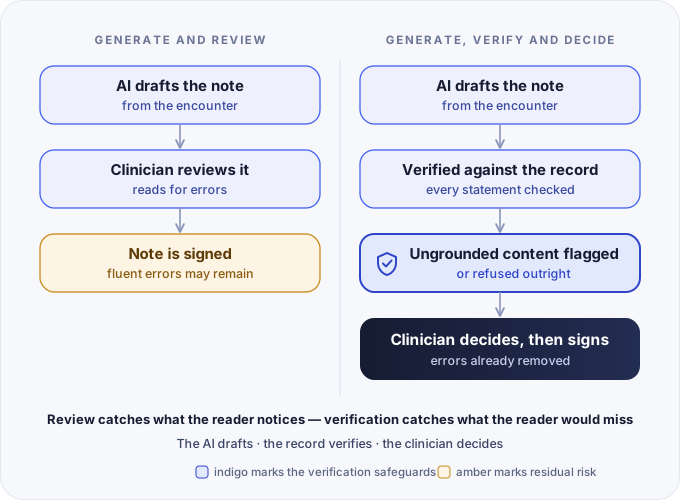
Review alone leaves fluent errors in the note; verification against the record removes them before the clinician reads it.
A clinician's checklist for trusting a documentation tool
Seven questions separate a tool you can rely on from one you cannot:
- Can every statement in the note be traced to the encounter or the record?
- Does the tool treat the assessment and plan — the reasoning-heavy sections — with extra care, since that is where errors concentrate?
- Does it show you what it could not verify, rather than hiding its uncertainty?
- Does it refuse or flag a gap instead of filling it with a plausible guess?
- Is there a clear point at which a human reviews and signs?
- Does the vendor publish its accuracy and, more tellingly, its limits?
- Is it clear who holds responsibility for the signed note? (You do.)
A tool that answers these well is not one that promises perfection. It is one that makes what you are signing easier to trust.
The clinician remains the authority
Responsibility for a signed clinical note remains with the signing clinician — the same standard that applies to an error made by a human scribe. The tool does not assume that responsibility and should never be described as if it did.
That is the final reason verification matters. The accountability was always the clinician's. A well-built system does not ask the clinician to carry more of it through vigilance; it carries its own share by refusing to put anything in the note that it cannot ground.
Frequently asked questions
Can AI medical scribes be trusted?
AI medical scribes can support clinical documentation, but trust should be earned rather than assumed. They can produce hallucinations — fluent, plausible content with no basis in the encounter — so a tool is trustworthy to the extent that it grounds its output in the record, flags what it cannot verify, and leaves the clinician as the final authority on the note.
What is an AI hallucination in a clinical note?
An AI hallucination in clinical documentation is content that is grammatically coherent and medically plausible but has no basis in the actual encounter or the patient's record. Examples include recording an examination that was not performed or a symptom that was never discussed.
How common are errors in AI-generated clinical notes?
Reported error and hallucination rates vary by tool and study, and tend to fall in the low single digits of content, though some studies report higher rates in simulated encounters. Errors concentrate in the assessment and plan sections, which require clinical reasoning, rather than in plain transcription. Human-authored notes also contain errors, so the relevant question is net risk and where it falls.
How can a clinician reduce the risk of AI hallucinations?
The durable safeguard is architectural rather than individual: use a tool built to ground every statement in the record, verify the draft against that record, refuse to assert what it cannot ground, and escalate matters needing judgement. Clinician review remains essential, with particular attention to the reasoning-heavy sections of the note.
Who is responsible if an AI-generated note contains an error?
Responsibility for a signed clinical note remains with the signing clinician, the same standard that applies to an error made by a human scribe. The documentation tool does not assume that responsibility.
Respocare Connect AI is a service line of Respocare (Pty) Ltd, a licensed South African healthcare practice.
Built by Respocare (PTY) Ltd — a licensed South African healthcare practice operating since 2018.