Beyond the Chatbot
Where our agentic clinical assistant is heading: a verified picture of each patient, an assistant that checks its own work, and delegation without autonomy.
Respocare Connect AI Team — Respocare (PTY) Ltd · Reg. 2018/411829/07 · Practice No. 9990900010775614. Licensed healthcare practice operating since 2018.
· 9 min read
Beyond the Chatbot: Where Our Agentic Clinical Assistant Is Heading
Clinicians do not need another chatbot. They need an assistant that knows the patient — and knows its place.
There is a version of clinical AI that most people can now picture. A text box. A question typed in. A fluent paragraph typed back. It is impressive, it is everywhere, and for medicine it is not enough.
The problem is not that the answers are poorly written. It is that a general chatbot answers from everywhere and nowhere — from the broad sweep of its training, not from the specific, accumulating, contradictory, half-scanned reality of the patient in front of you. A clinician who pastes a history into a chat window gets a confident response grounded in nothing the practice can verify. The answer may be right. The point is that nobody can show why it is right, or which document it rests on, or what it quietly ignored.
That gap — between a fluent answer and a grounded one — is where we are building.
Pasted-in answers versus governed answers
Consider the difference in mechanics, because it is larger than it looks.
A pasted-in answer depends on what the clinician remembered to paste. It carries no dates it can prove, no provenance, and no awareness of what sits three documents back in the record. When it is wrong, it is wrong invisibly.
An answer grounded in a governed record works the other way around. The assistant retrieves from the patient's actual documents — the referral letters, the investigations, the notes from previous providers — and every statement it makes can point back to where it came from. When the record does not contain enough to answer, the honest output is not a plausible paragraph. It is: the evidence for that is not here.
That distinction is the foundation of everything that follows, and it is expressed in one principle we repeat until it is boring:
The AI drafts. The record verifies. The clinician decides.
What "agentic" should mean in medicine
Agentic has become one of those words that means whatever the slide deck needs it to mean. So here is what we mean by it — and, just as importantly, what we do not.
An agentic clinical assistant can plan its way through a question rather than answering in one reflex: break the question down, gather evidence from across the record, check what it has gathered against what it is about to say, and state plainly what is missing. That is agency in the engineering sense — the ability to carry out a multi-step task under instruction.
What agentic does not mean, in our hands, is autonomy. The assistant does not act on its own judgement, because it does not have judgement in the sense that matters in medicine. It has process. The clinician directs the work, the record bounds the evidence, and the output is a draft awaiting a decision — never a decision.
You are not chatting with it. You are governing it.
Where this is heading
Three directions describe the assistant we are building toward. Each one is stated as direction, not as a shipped feature, because that is what it is.
A verified picture of each patient
Most clinical records are an archive, not a picture — a pile of documents in which the current truth has to be reconstructed on every visit. We are building toward an assistant that maintains a verified picture: one in which a result carries the date the report actually bears rather than the date it was uploaded, and in which two documents that disagree are shown side by side, as a conflict for the clinician to resolve, rather than silently reconciled by software. A system that hides its contradictions is not clean. It is dangerous in a way that looks clean.
An assistant that checks its own work
The failure that matters most in clinical AI is not the obvious error — it is the plausible one. So the direction of our engineering is an assistant that audits its own draft against its own sources before a clinician ever sees it: every material statement traced to a document in the record, and anything that cannot be traced either removed or flagged as unsupported. The aim is an assistant whose confidence is earned sentence by sentence, not projected across the whole answer.
From asking to delegating
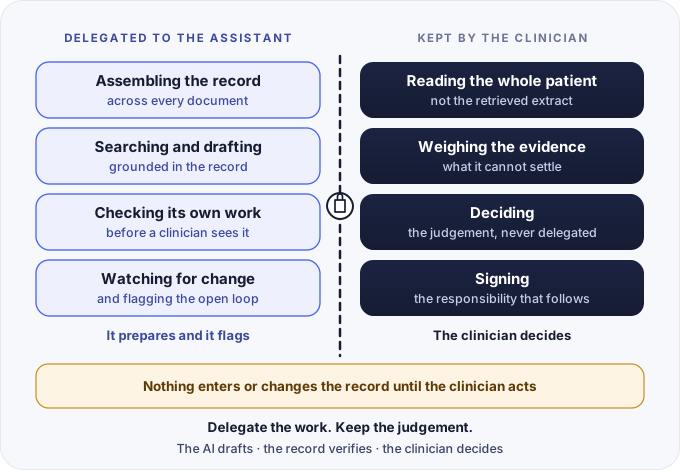
Today, clinical AI mostly waits to be asked. The more useful assistant is the one you can hand work to: prepare tomorrow's clinic from the records of the patients on the list; watch a patient's documents for change and surface it for review; keep track of the follow-up that was requested and flag the loop that has not closed. In every one of those, the assistant's role ends at the same line: it prepares and it flags. It does not act. The appointment is not changed, the letter is not sent, the record is not altered — until the clinician says so.
Delegation without autonomy is the whole design.
How we intend to prove it
Direction is cheap. Anyone can publish a roadmap. The harder commitment is to say in advance how you will measure whether the assistant is actually getting better — and then to be held to it.
Our approach rests on three disciplines. First, a published evaluation standard: the behaviours that matter — grounding, completeness, the discipline to defer — defined and scored the same way every time, so improvement means something. Second, blind review: the work is assessed without knowledge of which version produced it, so the scoring cannot flatter the newest release. Third, clinician ratification: no result is treated as clinically meaningful until a clinician has signed the key it was scored against.
What that allows us to say, over time, is not "trust us" but something more useful: measurably improving against a published standard. And when a test finds the opposite — when a change makes the assistant worse — that belongs in the record too. We write about our faults in the same publication, at the same length, as our progress, because a company that only reports its good weeks is asking you to do the verification it should be doing itself.
What we will not build
A direction statement is only honest if it includes the destinations we are refusing.
We will not build an autonomous AI doctor. We will not build prescribing. We will not build anything that changes a patient's record without the clinician's explicit action. And we will not build invisible behaviour — actions a system takes that the person responsible for the patient cannot see, inspect, or reverse.
These are not temporary limitations waiting on better models. They are design commitments, because the question that governs clinical AI is not what can the technology do but who remains responsible — and the answer, in medicine, does not change as the technology improves.
Respocare Connect AI is a clinical assistant and documentation platform. It is not a medical device, it is not diagnostic, and it is not a substitute for clinical judgement; every output requires independent clinician review. Any patient examples we publish are synthetic evaluation records, built for testing, and labelled as such.
The work, and the judgement
The deepest promise of this technology is often described as saving time. We think that undersells it — and slightly misses it.
What an agentic assistant actually offers the clinician is a different division of labour: delegate the assembling, the searching, the drafting, the watching — the work that consumes the day without requiring a medical degree — and keep what cannot be delegated, which is the judgement. The reading of the whole patient. The weighing of what the evidence cannot settle. The decision.
Delegate the work. Keep the judgement.
That is the direction. We will keep publishing what we find on the way there — including the weeks it does not go to plan.
Respocare Connect AI publishes The Agentic Report, a weekly account of this work, every Wednesday — faults included.
Frequently asked questions
What is an agentic clinical assistant?
An AI assistant that can carry out multi-step clinical work under a clinician's direction — planning a task, gathering evidence from the patient record, checking its draft against its sources, and stating what is missing. It prepares work and flags findings for review; it does not act on its own.
Is an agentic clinical AI the same as an autonomous AI?
No. Agentic describes how the system works through a task; autonomous describes who decides. In our design the assistant never decides: it drafts, the record verifies, and the clinician makes every decision.
Can Respocare Connect AI diagnose patients?
No. Respocare Connect AI is a clinical assistant and documentation platform, not a medical device. It does not diagnose, and every output requires independent review by the treating clinician.
How do you measure whether a clinical AI assistant is improving?
Against a published evaluation standard, with blind review and clinician-ratified scoring keys, so that improvement is demonstrated rather than claimed.
Will the assistant take actions in the patient record?
No. It prepares drafts and flags items for review. Nothing enters or changes a patient's record without the clinician's explicit action.
Built by Respocare (PTY) Ltd — a licensed South African healthcare practice operating since 2018.