From Home Oxygen to Clinical AI
A decade of respiratory homecare taught Respocare what hospitals miss: the record is the patient’s story. Why a healthcare practice built its own clinical AI.
Respocare Connect AI Team — Respocare (PTY) Ltd · Reg. 2018/411829/07 · Practice No. 9990900010775614. Licensed healthcare practice operating since 2018.
· 6 min read
From Home Oxygen to Clinical AI: Why Respocare Built It
Respocare did not set out to build software. We set out, in 2018, to keep people with respiratory disease breathing well at home. Clinical AI is what that work eventually demanded.
This is the story of the connection, because it explains almost every design decision in Respocare Connect AI.
What homecare teaches that hospitals cannot
A hospital sees a patient in episodes. An admission, a discharge, a follow-up. A home oxygen provider sees the space between the episodes — which is where chronic disease actually lives.
A patient on long-term oxygen therapy is not a case. They are a decade. Their story runs through a pulmonologist's letters, a GP's notes, hospital discharge summaries, oxygen prescriptions, saturation readings, equipment records and family phone calls. No single clinician holds all of it. Often, no single system does either.
Working in that space for years taught us three things that became the foundations of Connect AI.
The record is the patient
In chronic care, the question is almost never "what is happening now?" in isolation. It is "what is happening now, against everything that came before?" A saturation of 91 percent means one thing in a patient whose baseline is 96 and another in a patient who has lived at 90 for five years. Without the history, the present is unreadable. That is why Connect AI is built around what we call the living record — the patient's full documentary history, kept in one place, consulted on every question.
Fragmentation is the quiet failure mode
The dangerous moment in chronic care is rarely dramatic. It is the baseline value nobody can find, the allergy recorded in one system and absent from another, the trend that only becomes visible when ten years of results sit in one table. Homecare providers spend an extraordinary amount of time reassembling stories that should never have come apart. Connect AI's Document Intelligence instrument exists because we did that reassembly by hand for years.
Trust is earned in the home, slowly
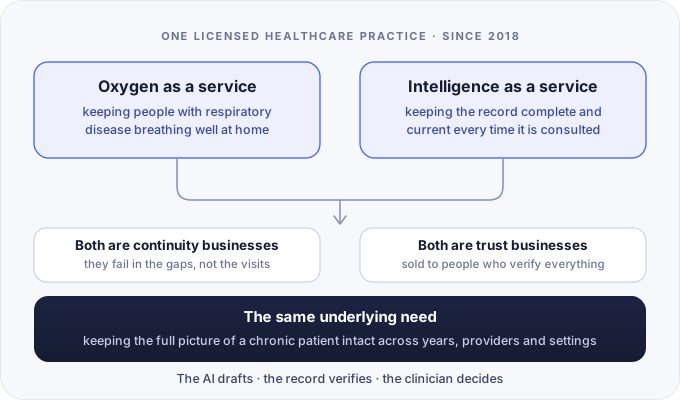
A homecare practice is let into people's houses. That kind of trust is not won with claims; it is won with reliability, honesty about limits, and showing up. We carried that standard into the AI work. It is why we state plainly that clinical validation is ongoing, why every output requires independent clinician review, and why our governing sentence puts the clinician last and decisive: the AI drafts, the record verifies, the clinician decides.
Why a practice built it, rather than buying it
Most clinical AI is built by technology companies moving towards medicine. Respocare Connect AI was built the other way around: by a licensed South African healthcare practice moving towards technology, because the tools we needed for our own patients did not exist in the form we could trust.
The difference shows in priorities. A technology company optimises for the demonstration — the fluent answer, the impressive summary. A practice optimises for the Tuesday afternoon: the clinician mid-clinic who needs the baseline creatinine from 2019, cited to its source document, in seconds, with anything missing flagged rather than papered over.
It also shows in restraint. We have written elsewhere about why a cited answer is not automatically a safe answer, and why we treat our own system's safety features as claims to be tested rather than assumed. That instinct comes from clinical practice, where overconfidence has a body count, not from software culture, where it has a marketing budget.
Two service lines, one practice
Respocare today runs two service lines under one practice: oxygen as a service, and intelligence as a service.
They are more connected than they look. Both are continuity businesses. Oxygen therapy only works if it is there every hour of every day; a clinical record only works if it is complete and current every time it is consulted. Both are trust businesses, sold to clinicians and families who will verify everything. And both answer the same underlying need — keeping the full picture of a chronic patient intact across years, providers and settings.
Connect AI is that need, engineered: six instruments — document intelligence, an agentic clinical assistant, a medical AI scribe, clinical report generation, a ward round checklist and vitals triage — all built on the living record, all designed so that every claim traces to a source and every decision remains the clinician's.
Where this goes
Respiratory homecare was the proving ground because chronic respiratory disease is the hardest version of the continuity problem: long histories, many providers, high stakes, fragile patients. A system designed to hold that together is designed to hold most of medicine together.
That is the ambition, stated with the discipline the clinic taught us: the architecture is built; the clinical validation is ongoing; and the clinicians using it, not the company selling it, will be the judges of whether a decade of homecare produced something worthy of their patients.
Respocare Connect AI is a clinical assistant and documentation platform built by Respocare (PTY) Ltd, a licensed South African healthcare practice established in 2018. It is not a medical device, it is not diagnostic, and every output requires independent clinician review.
Frequently asked questions
Why did a home oxygen company build clinical AI?
Because a decade of respiratory homecare showed that the biggest everyday risk in chronic care is a fragmented record — histories scattered across providers and systems. Respocare built Connect AI to keep a patient's full documentary history in one living record that clinicians can question and verify.
What is the connection between home oxygen therapy and clinical AI?
Both are continuity problems. Oxygen therapy succeeds only through unbroken daily reliability, and chronic care decisions succeed only when the present is read against the full history. Clinical AI built around a complete, citable patient record applies the same continuity principle to information.
Is Respocare a technology company or a healthcare practice?
Respocare (PTY) Ltd is a licensed South African healthcare practice established in 2018, running two service lines: respiratory homecare and the Respocare Connect AI clinical platform. The AI was built from within clinical practice, not acquired from outside it.
What is the living record in Respocare Connect AI?
The living record is the patient's complete documentary history — letters, results, notes and reports — held in one place and consulted on every question the system answers, so that answers are drawn from and cited to the patient's own record.
Keep reading
Built by Respocare (PTY) Ltd — a licensed South African healthcare practice operating since 2018.