How Much Time Does Clinical AI Save?
The honest numbers on clinical AI and clinician time: what the largest studies actually measured, where the saved minutes went, and how to test it yourself.
Respocare Connect AI Team — Respocare (PTY) Ltd · Reg. 2018/411829/07 · Practice No. 9990900010775614. Licensed healthcare practice operating since 2018.
· 10 min read
How Much Time Does Clinical AI Actually Save — and What Should You Do With It?
By Matthew Hellyar, Founder, Respocare Connect AI
Every clinical AI vendor promises you time. Few show the arithmetic, and almost none answer the better question: time for what?
Here are the honest numbers. Some are smaller than the headlines. One of the most-quoted benefits does not survive the largest controlled study. And the most interesting finding is not about minutes at all — it is about where the minutes went.
The size of the hole
The documentation burden is one of the best-quantified problems in medicine.
A landmark time-and-motion study in the Annals of Internal Medicine followed 57 physicians across four specialties and found that for every hour of direct clinical face time with patients, nearly two further hours went to the EHR and desk work. Across the office day, 27 percent of time went to patients and 49 percent to the record. The day did not end at the clinic: physicians reported another one to two hours of personal time each night on clerical work — the hours the literature has since named pajama time.
| Where a clinic day goes | Share |
|---|---|
| Direct face time with patients | 27% |
| EHR and desk work | 49% |
| Everything else | 24% |
| After hours, at home | +1–2 hours per night |
The profession did not train for the middle row. Burnout research keeps finding it there anyway.
What the evidence says about getting time back
Two large studies dominate this question, and they do not entirely agree. The disagreement is the most useful thing in the literature, so take them in order.
The largest deployment. At The Permanente Medical Group, ambient AI scribes were used by 7,260 physicians across 2,576,627 patient encounters over 63 weeks. The reported saving was 15,791 hours of documentation time — about 1,794 eight-hour working days — alongside reductions in note time, time per appointment and after-hours work.
The largest controlled comparison. In April 2026 the Journal of the American Medical Association published a multisite study of 8,581 clinicians at five US academic health systems, comparing 1,809 who adopted an AI scribe against 6,772 who did not. Per eight scheduled patient hours, adoption was associated with 16.0 fewer minutes of documentation time (95% CI, 13.7 to 18.3) and 13.4 fewer minutes of total EHR time (95% CI, 9.1 to 17.7). The authors call the effect modest. It is also real, measured against a control group, and consistent in direction with everything else published.
The part most summaries leave out
The same study looked for a reduction in after-hours EHR time and did not find a significant one. The point estimate was 3.1 fewer minutes per eight patient hours, with a confidence interval running from 6.8 fewer to 0.5 more — a range that includes no change at all. Among the heaviest users it was 5.5 fewer minutes, and still not significant.
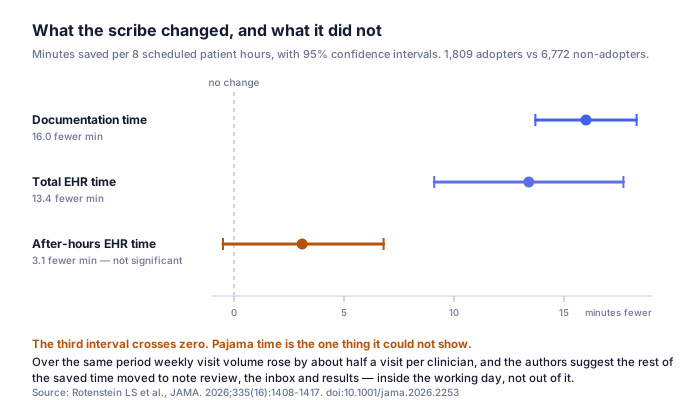
Pajama time is the thing clinicians most want back, and the largest controlled study to date could not show that an AI scribe returns it.
So where did the saved documentation time go? The authors offer the likely answer, and the same study measured part of it: weekly visit volume rose by about half a visit per clinician. They suggest the remainder was reallocated inside the working day — reviewing notes, answering inbox messages, handling results.
This is the finding that should change how a practice buys. The time is real. Its destination is not automatic. Left alone, a clinic under pressure will absorb reclaimed minutes into the next task, and a clinician can finish the year having genuinely saved an hour a week and felt none of it.
Ask for the denominator
Headline hours come from enormous volume. Do the division before you are impressed by one.
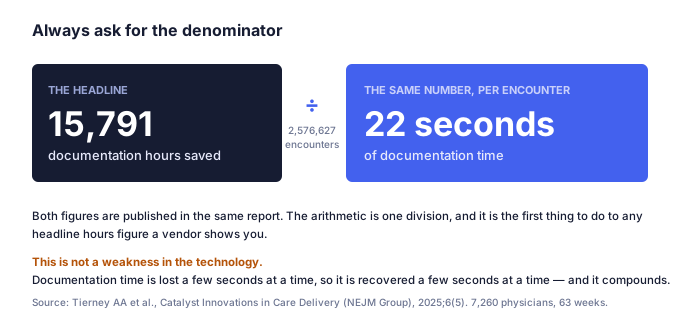
Fifteen thousand seven hundred and ninety-one hours is a commanding number. Spread across 2,576,627 encounters it is about 22 seconds per encounter. Both figures are published in the same report; the arithmetic is one division, and it is the first thing to do to any headline a vendor shows you — including ours.
That is not a weakness in the technology. It is how documentation time works: it is lost a few seconds at a time, so it is recovered a few seconds at a time, and it compounds. Sixteen minutes per eight-hour clinical day, across roughly 240 clinical days, is about 64 hours a year. A week and a half of working time, recovered from the keyboard. Worth having. Not a transformation, and nobody should sell it as one.
One more figure belongs here, because it is the one a practice can act on. Clinicians who used the scribe on at least half their visits saw 27.3 fewer minutes of documentation time and 21.3 fewer minutes of total EHR time per eight patient hours — two to three times the average effect. Only about 32 percent of adopters used it that often. The variable that most predicts whether a practice gets the published result is not the product. It is whether the tool is used consistently enough to produce one.
Where our own figure sits
Stated once, and bound to its conditions: in our 2026 internal evaluation across 200 cases, Respocare Connect AI's documentation workflow reduced note time by 73%, with average note-completion time falling from 18 minutes to under five.
That is an internal figure from a structured internal test, not an independent clinical validation, which is ongoing. It appears after the external evidence deliberately, and it is subject to the same denominator question we just asked of everyone else.
Time is the floor. The ceiling is what you do with it
Here is where the conversation usually stops, and where it should begin. A scribe gives you minutes back; it does not change what your practice is capable of. We have argued elsewhere that the scribe is clinical AI's entry exam, not its ceiling. The reclaimed time is only the first dividend. The second is capability, and Connect AI is engineered for four of them.
Seeing the whole patient story. Documentation is the writing problem. Fragmented records are the reading problem, and the reading problem is where chronic-care time really disappears — hunting a baseline value from six years ago, reconciling three providers' letters, assembling a decade of results into one trend. A living record that answers questions with cited sources is built to turn an afternoon of reconstruction into a question.
Raising the quality of the record itself. Time pressure is why notes thin out and histories go unreconciled. A practice that documents faster is positioned to document better — fuller notes, consistent structure, fourteen report formats drafted from the record rather than from memory, every draft reviewed and signed by the clinician.
Faster letters, reports and referrals. Turnaround on correspondence is one of the quiet markers by which colleagues and funders judge a practice. Drafting from the record is engineered to compress days of backlog into same-day review.
Capacity on your own terms. This is the one the evidence makes urgent. The multisite data suggest reclaimed hours get allocated whether or not you allocate them. Decide in advance: more patients, longer consultations, teaching, research, or going home on time. The last of those is not a luxury. It is the intervention the burnout literature keeps pointing at.
That is the real meaning of advancing your practice: not seeing more patients faster, but practising closer to the standard you trained for, with the record working for you instead of the reverse.
Measure it in your own practice
Do not take the published numbers — or ours — on faith. Time savings are measurable in any practice in 30 days, and after the 2026 findings the protocol needs a fourth step.
- Baseline, week one. Note your time per note (most EHRs report it), your after-hours record time, and your correspondence backlog.
- Trial, weeks two to five. Introduce the tool into real workflow. Change nothing else — and track how often you actually use it, because intensity of use is what separated the average result from the good one.
- Measure the same three numbers. Minutes per note, pajama time, backlog age.
- Then find out where the time went. Did the clinic finish earlier, or did the saved minutes move to the inbox? Did note quality hold under your own review? Would you give it up?
A vendor confident in its product will welcome this protocol. We do — and because any trial means patient data, start with what happens to patient data inside the platform before you start the clock.
The principle underneath
Respocare Connect AI is built on one sentence: the AI drafts, the record verifies, the clinician decides. Time savings are what that principle produces as a by-product. The draft arrives in seconds instead of your evening; the record answers in moments instead of an afternoon; and the deciding — the part that is actually medicine — keeps the clinician, with more of their day in which to do it.
Whether that day ends earlier is still, on the published evidence, up to the practice. That is the honest version, and it is the one worth buying on.
Respocare Connect AI is a clinical assistant and documentation platform. It is not a medical device, it is not diagnostic, and every output requires independent clinician review. The note-time figure is from a 2026 internal evaluation across 200 cases under its stated conditions; independent clinical validation is ongoing. Built by Respocare (PTY) Ltd, a licensed South African healthcare practice operating since 2018.
References
- Sinsky C, et al. Allocation of Physician Time in Ambulatory Practice: A Time and Motion Study in 4 Specialties. Annals of Internal Medicine. 2016;165(11):753–760. doi:10.7326/M16-0961
- Tierney AA, et al. Ambient Artificial Intelligence Scribes: Learnings After 1 Year and Over 2.5 Million Uses. Catalyst Innovations in Care Delivery (NEJM Group). 2025;6(5).
- Rotenstein LS, Holmgren AJ, Thombley R, et al. Changes in Clinician Time Expenditure and Visit Quantity With Adoption of Artificial Intelligence–Powered Scribes: A Multisite Study. JAMA. 2026;335(16):1408–1417. doi:10.1001/jama.2026.2253
- Olson KD, et al. Use of Ambient AI Scribes to Reduce Administrative Burden and Professional Burnout. JAMA Network Open. 2025;8(10):e2534976. Published 2 October 2025. doi:10.1001/jamanetworkopen.2025.34976
Related reading
- Should clinical AI stop at the scribe? — what licenses each step beyond documentation.
- What an agentic clinical assistant actually does — the five behaviours the reading problem needs.
- Northstar — the engineering programme behind the capability half of this article.
Keep reading
Built by Respocare (PTY) Ltd — a licensed South African healthcare practice operating since 2018.