Northstar: Longitudinal Clinical AI
Inside Northstar, the engineering programme behind Respocare Connect AI: longitudinal clinical intelligence, agentic investigation, and proof before promise.
Respocare Connect AI Team — Respocare (PTY) Ltd · Reg. 2018/411829/07 · Practice No. 9990900010775614. Licensed healthcare practice operating since 2018.
· 12 min read
What If Your Clinical Assistant Understood the Entire Patient Story?
Inside Northstar: the next evolution of Respocare Connect AI
By Matthew Hellyar, Founder, Respocare Connect AI
Imagine opening your next patient consultation and having years of clinical context available to you.
Not scattered across documents. Not hidden in old consultation notes. Not something you have to reconstruct manually.
An intelligent clinical assistant that can help you understand what has happened, investigate what matters, and present the evidence in a way you can actually use.
That is the direction we are taking Respocare Connect AI.
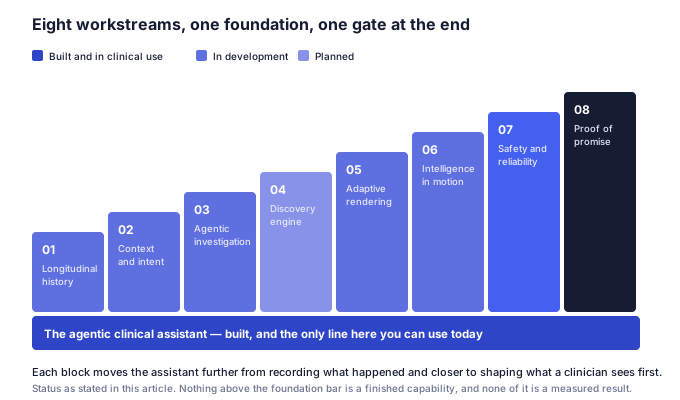
We have already built and launched our agentic clinical assistant. Now, through an eight-stage engineering programme called Northstar, we are enhancing how that intelligence understands, investigates and communicates clinical information.
To explain what we are building, let us walk through a patient encounter.
Where Northstar stands today
Most announcements in this industry describe finished products. This one does not, and the distinction matters enough to put at the top rather than bury in a footnote.
| Workstream | What it is for | Where it stands |
|---|---|---|
| The agentic clinical assistant | Retrieval before the answer, citation to the record, refusal when the record will not support a claim | Built and in clinical use |
| 01 Longitudinal Clinical Intelligence | Reconstructing the patient's history as a sequence of events | Designed; in development |
| 02 Contextual Intelligence and Intent | Holding meaning across follow-up questions and corrections | In development |
| 03 Agentic Clinical Investigation | Organising a multi-step enquiry and judging evidence sufficiency | In development |
| 04 The Clinical Discovery Engine | Surfacing the patient-specific questions nobody asked | Planned |
| 05 Adaptive Clinical Response Renderer | Tables, timelines, graphs and drafts instead of paragraphs | In development |
| 06 Clinical Intelligence in Motion | An interface that shows real system activity, not theatre | In development |
| 07 Safety, Performance and Reliability | Correctness, grounding, isolation, speed, cancellation | Continuous, every stage |
| 08 Integrated Proof of Promise | The evidence gate the whole programme answers to | The gate at the end |
The right-hand column uses exactly the language of the sections below. Nothing is described as finished unless it is finished, and the one line that says built is the one you can use today.
Meet Richard Collins
Richard is a fictional patient we created for clinical AI evaluation. His medical history spans almost ten years, distributed across 150 clinical documents.
He has a history of diabetes, hypertension, ischaemic heart disease, chronic kidney disease and other conditions. Over the years he has undergone investigations, received different medications and attended numerous consultations.
His story is not contained in one document. It exists across many.
And that is where our story begins.
01. Longitudinal Clinical Intelligence: The Patient Story, Not Just the Latest Note
A clinician opens Richard's record and asks:
Give me an overview of Richard's clinical history.
A conventional AI assistant might summarise the most recently retrieved documents. But a patient's clinical history is not simply a collection of summaries. It is a sequence of events.
Northstar's Longitudinal Clinical Intelligence work is designed to reconstruct that sequence, helping the clinician understand how Richard's conditions have evolved, what his laboratory results show over time, when medications were introduced or changed, which findings appear to contradict one another, and where the available clinical evidence is incomplete.
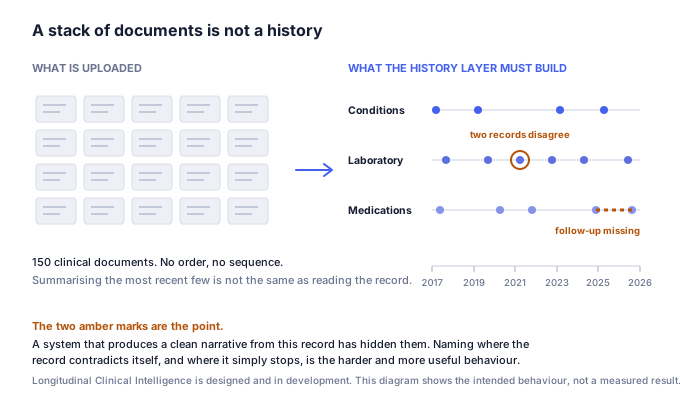
Crucially, the assistant must distinguish what is documented from what is uncertain. The objective is not to create a more convincing narrative.
It is to create a more accurate understanding of the patient.
This is the hardest of the eight, and it is first for a reason: every workstream after it inherits whatever the history layer gets wrong.
02. Contextual Intelligence and Intent: A Conversation That Actually Understands
Now imagine the clinician asks:
What about his kidney function?
The assistant retrieves relevant evidence from Richard's clinical record. Then the clinician follows up:
And earlier?
Two words. But those two words carry meaning from the previous conversation. The clinician is asking about Richard's kidney function at an earlier point in time, not requesting an unrelated search.
This is the purpose of Contextual Intelligence and Intent. We are strengthening the assistant's ability to maintain context across follow-up questions, understand corrections, and recognise when a request is ambiguous. Where necessary it must retrieve additional evidence rather than relying on conversational memory alone.
That distinction is the safety-critical one. Conversational memory is a summary of what was said; the record is the evidence. A follow-up answered from memory can inherit an error the record would have corrected.
Because in medicine, understanding the question is just as important as answering it.
03. Agentic Clinical Investigation: From Answering to Investigating
The next question becomes more involved.
Can you investigate the changes in his kidney function alongside his medication history?
Now the task requires more than retrieving one document. The assistant may need to examine laboratory records, reconstruct medication chronology, compare dates and identify where supporting information is missing.
This is where Agentic Clinical Investigation becomes important. Our goal is to strengthen the assistant's ability to organise an investigation across multiple steps, select appropriate tools, and evaluate whether the available evidence is sufficient.
And equally importantly, to recognise when it is not.
The assistant should not invent a clinical relationship just because two events happened around the same time. It should present the evidence, identify uncertainty, and leave clinical interpretation and decisions with the medical professional.
Two events in the same month are a coincidence until the record says otherwise. A system that cannot hold that line will produce its most confident answer exactly where a patient is least well documented.
Intelligence should investigate responsibly, not manufacture certainty.
04. The Clinical Discovery Engine: What About the Questions Nobody Asked?
Here is where things become particularly interesting.
The clinician has asked about kidney function and medication history. But what if the available records contain another relevant question worth exploring?
Perhaps a laboratory trend has incomplete follow-up documentation. Perhaps two historical records disagree. Perhaps a medication change lacks a clearly documented date.
Northstar's planned Clinical Discovery Engine is designed to help surface those patient-specific questions and evidence gaps.
Not as autonomous diagnoses. Not as instructions to change treatment. But as opportunities for the clinician to investigate further.
Imagine an assistant that does not only help you answer your questions.
It helps you recognise which questions might deserve your attention next.
That is a fundamentally different ambition from generating text.
05. Adaptive Clinical Rendering: Clinical Information Should Not Live in Endless Paragraphs
Let us return to Richard.
The clinician now wants to review his kidney function over time. Would another 600-word explanation really be the best way to present that information?
Probably not.
A laboratory trend may be better understood as a graph. Medication changes may be easier to interpret along a timeline. Conflicting records may be clearer in a comparison table.
Our Adaptive Clinical Response Renderer is being developed around this principle. The system should adapt its presentation to the clinical question, producing appropriate tables, timelines, graphs, comparisons, structured reports and editable drafts, all grounded in the supporting patient evidence.
The clinician should also be able to inspect the relevant sources and review or edit generated documentation.
The goal is not simply better answers. It is making those answers easier to work with, and easier to check. A table with a column of dates is auditable in a way a paragraph never is.
06. Clinical Intelligence in Motion: An Experience That Feels Like a Workspace
There is another part of clinical AI that deserves more attention: the experience itself.
When an assistant is investigating a complex patient record, a clinician should not have to stare at a loading indicator without any meaningful feedback.
We are developing Clinical Intelligence in Motion to make the experience more responsive and transparent. Picture an elegant clinical workspace where the interface can indicate when information is being retrieved, when evidence is being processed, and when a response is ready.
Progress indicators must reflect genuine system activity, not theatrical animations pretending to reveal reasoning. Streaming responses, responsive layouts and carefully considered design all contribute to the experience.
That is not a cosmetic requirement. An indicator that invents progress is a small, continuous lie about what the system is doing, and a clinician who learns to distrust the interface will learn to distrust the output.
Because good clinical technology should not demand unnecessary attention. It should help you focus yours.
07. Safety, Performance and Reliability: What Happens Behind the Interface
Everything described above depends on a critical foundation: trust.
A clinical assistant can look impressive and still be unreliable. That is why Safety, Performance and Reliability is an explicit Northstar development stage rather than a review at the end.
We are focusing on clinical correctness, source grounding, patient isolation, cancellation behaviour, response speed and operational reliability.
The system must respect the boundaries of the available record. If an answer cannot be supported, it must communicate that limitation. If evidence is contradictory, it must not silently choose whichever version produces the most confident-sounding answer. We have written before about why a cited answer is not automatically a safe answer, and Northstar treats that finding as a requirement, not a footnote.
And clinical decisions must remain with the qualified professional.
At Respocare Connect AI, human oversight is not something we intend to add after building the intelligence.
It is part of the foundation on which the intelligence is built.
08. Integrated Proof of Promise: Now We Have to Prove It
We can describe all of these capabilities. We can design beautiful interfaces. We can demonstrate impressive individual responses.
But none of that, by itself, establishes that the complete system performs reliably.
That is why Northstar culminates in an Integrated Proof of Promise.
We return to Richard Collins, the same synthetic patient, with his extensive medical history, clinical complexity and longitudinal records, and test how the capabilities work together across our nine intelligence evaluation attributes.
Can the assistant retrieve the right information? Can it preserve clinical context? Can it follow evidence across years? Can it identify contradictions without inventing explanations? Can it stop when the available evidence is insufficient? And can it do all of this reliably, safely and efficiently?
A proof that only the builder can run is not proof. The reason this stage exists as a named stage, with its own gate, is that it is the one a reader outside the company can eventually hold us to.
These are the questions we want our engineering work to answer. We intend to share the progress, the challenges and what the results actually demonstrate.
Because the real measure of clinical AI is not how impressive it sounds.
It is how well it performs when the questions become difficult.
The Future of Clinical Intelligence Is More Than a Chatbot
Richard Collins is fictional. But the problem he represents is very real.
Medical professionals encounter fragmented histories, complex documentation and growing demands on their time every day. We have argued elsewhere that clinical AI must earn each step beyond documentation. Northstar is how we intend to earn ours, in public.
Our ambition has never been to place another chatbot in front of those problems. It is to build an intelligent clinical ecosystem that can work alongside the people responsible for patient care. An ecosystem that remembers clinical context, investigates evidence responsibly, identifies relevant gaps, and helps turn information into something useful.
Northstar is the next step in that journey. Eight engineering stages. One existing agentic clinical assistant. And a commitment to building in public, testing rigorously, and remaining transparent about what we have achieved and what we are still working towards.
The AI drafts, the record verifies, the clinician decides.
The clinician remains in control. The intelligence is there to serve them.
Welcome to Northstar.
Matthew Hellyar Founder, Respocare Connect AI
Built on service. Driven by innovation.
Respocare Connect AI is a clinical assistant and documentation platform. It is not a medical device, it is not diagnostic, and every output requires independent clinician review. Richard Collins is a synthetic test patient created for evaluation; no real patient data appears in this article. Built by Respocare (PTY) Ltd, a licensed South African healthcare practice operating since 2018.
Related reading
- What an agentic clinical assistant actually does — the five behaviours the existing assistant is built around.
- Should clinical AI stop at the scribe? — the ladder of responsibility Northstar is climbing, and what licenses each step.
- Why a cited answer is not automatically a safe answer — the finding stage 07 treats as a requirement.
- Longitudinal reasoning and the living record — what the history layer is built on.
- Beyond the chatbot — where the agentic assistant was already heading.
Keep reading
Built by Respocare (PTY) Ltd — a licensed South African healthcare practice operating since 2018.