Should AI Stop at the Scribe?
The AI scribe is clinical AI's one proven win. The case for stopping there, where it fails, the five-step ladder beyond it, and the checklist for every buyer.
Respocare Connect AI Team — Respocare (PTY) Ltd · Reg. 2018/411829/07 · Practice No. 9990900010775614. Licensed healthcare practice operating since 2018.
· 13 min read
Should Clinical AI Stop at the Scribe? The Honest Case
The ambient scribe is clinical AI's one unambiguous success. There is a serious argument that the industry should declare victory there and go no further. We sell a platform that goes further, so we owe that argument an honest hearing before we answer it — and clinicians deserve better than either side's marketing.
This article makes the strongest version of the stopping case, shows precisely where it fails, and leaves you with the ladder and the checklist to judge any vendor, including us.
The case for stopping at the scribe
It rests on four observations, and each one is strong.
1. The scribe sits at the safest point in the clinical encounter. A scribe documents a decision the clinician has already made, in the clinician's presence, for the clinician's review before signing. The human is the author; the machine is the typist. Every step beyond that — retrieving, summarising, suggesting — moves the machine earlier in the reasoning chain, to where its output can shape the decision rather than record it. The risk gradient is real, and it is steep.
2. The evidence beyond the scribe is sobering. In a randomised trial published in JAMA Network Open in October 2024, fifty physicians were randomised to conventional diagnostic resources with or without a large language model. The model working alone scored a median of 92% on the diagnostic reasoning rubric — sixteen percentage points above the physicians working conventionally (95% CI 2 to 30; p = 0.03). The physicians given access to that same model scored 76% against 74% without it: an adjusted difference of two percentage points, well inside the noise (95% CI −4 to +8; p = 0.60). [1]
In October 2025 the same journal reported burnout prevalence falling from 51.9% to 38.8% across 263 clinicians using an ambient AI scribe for thirty days. [2] One class of tool has measured human benefit; the other, at that point, had mostly measured capability. A rational buyer notices the asymmetry.
3. Burnout is the actual crisis. Clinicians are not short of diagnostic opinions. They are short of hours, and documentation is where the hours go. The scribe attacks the real problem directly. Everything beyond it attacks problems that are arguably rarer, and introduces a new one: a fluent, confident machine opinion arriving before the clinician's own.
4. The regulatory ground is firmest under the scribe. A documentation tool reviewed and signed by its clinician author sits cleanly on the tool side of the medical-device line. Each step towards suggestion and decision support moves towards murkier territory. Stopping at the scribe is not just cautious medicine; it is cautious law.
Taken seriously — and it should be — the argument says: the scribe is where capability, evidence, demand and regulation all align. Stop there.
What the newer evidence changes
The stopping case leans hard on that 2024 null result, and for two years it was the best evidence anyone had. It is no longer the only evidence.
In 2026, npj Digital Medicine published a randomised trial of seventy clinicians that held the class of model roughly constant and changed the workflow around it. Rather than handing clinicians a chatbot, the system had the clinician and the AI each assess the case independently, then generated a synthesis placing the two assessments side by side — marking where they agreed, where they disagreed, and offering commentary on each. [3]
Clinicians using conventional resources scored 75%. With the AI giving a first opinion, 85% — a mean difference of 9.9 percentage points (95% CI 4.7 to 15.0; p = 0.0004). With the AI giving a second opinion, 82% — 6.8 percentage points (95% CI 4.0 to 9.6; p < 0.001).
What makes that comparison unusually clean is methodological rather than rhetorical: the 2026 trial reused the 2024 trial's clinical vignettes, case structure and scoring scheme, and shares several investigators. These are not two studies that happen to point in different directions. They are closer to the same experiment run twice, with the workflow as the variable.
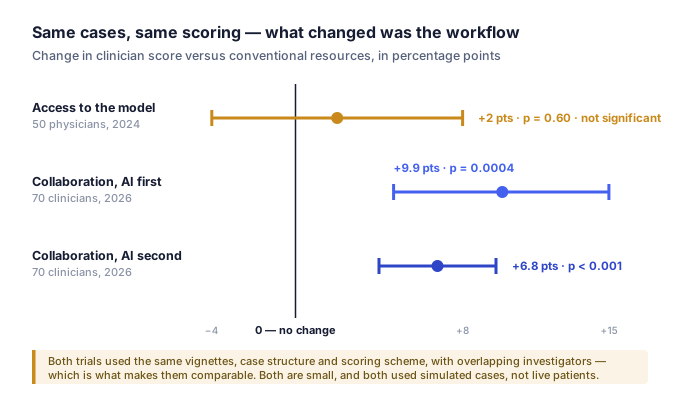
So the honest reading of the null result is narrower than it first appears. It did not show that clinical AI beyond the scribe fails to help clinicians. It showed that handing a clinician access to a capable model, with nothing designed around it, fails to help. Access is not an intervention. The design is the intervention.
The uncomfortable half of the same finding
The collaborative arms were not significantly better than the AI working alone. [3] That deserves stating plainly, because it is the opposite of a marketing point.
The safeguards did not make the system cleverer. What they did was let the clinician actually capture capability that had been sitting unused in front of them two years earlier. The ladder below is not a way of making AI better. It is the mechanism by which a clinician can safely use what the machine already knows — and it earns its place because without it, as the 2024 trial showed, the capability simply does not transfer.
Where the argument fails: the reading problem
The scribe solves the writing problem and leaves the reading problem untouched.
A consultation is one document; a chronic patient is hundreds, scattered across providers and years. The everyday failures of chronic care are retrieval failures: the baseline creatinine from 2019 nobody can find, the allergy recorded in one system and absent from another, the trend that only appears when a decade of results sits in one table. A scribe, by definition, cannot help. It writes the present; the danger lives in the past.
Put concretely, here is what a clinician still does by hand on the day the scribe goes live:
| Daily task | Scribe helps? |
|---|---|
| Documenting today's consultation | Yes — this is the win |
| Finding a baseline value from years ago | No |
| Reconciling records from three providers | No |
| Seeing a ten-year trend in one view | No |
| Drafting a referral or report from the history | No |
| Preparing for a ward round across the record | No |
Five of six are reading problems. That is the territory the stopping argument cedes — and it does not stay empty.
Shadow AI: what "stopping" produces in practice
Demand does not stop where the sanctioned product stops. Clinicians denied governed tools for the reading problem are already solving it ungoverned — pasting patient records into consumer chatbots with no identity controls, no practice isolation, no source citations and no audit trail. This is shadow AI in healthcare, and it is the predictable result of a policy that blesses the scribe and bans the rest.
So "clinical AI should stop at the scribe" does not, in practice, stop clinical AI. It stops accountable clinical AI, and routes the reading problem to the least accountable tools available. The stopping argument, followed sincerely, delivers the opposite of the safety it promises. The practical question for a clinical director is not "scribe or more?" but "will the more happen inside governance, or outside it?"
There is a quieter problem too: the scribe is not as far from the reasoning chain as the argument assumes. A summary is already an act of judgement — what to include, what to omit, what to foreground. Even the "safe" instrument needs the governance the argument says only the dangerous ones require. The line was never scribe versus not-scribe. It was governed versus ungoverned.
The ladder: what earns each step beyond the scribe
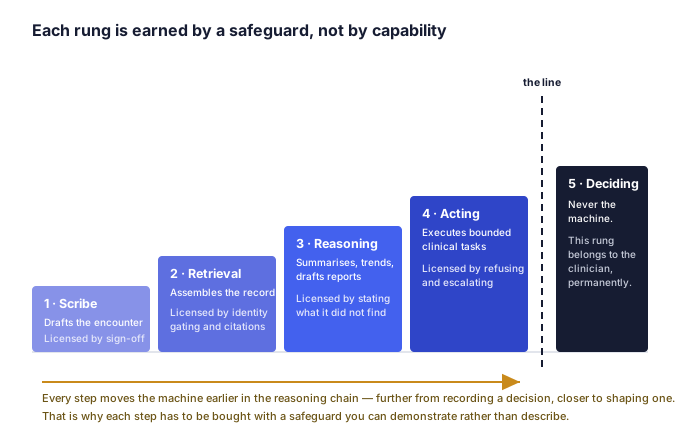
Our answer is that each step must be earned, and that what earns it is a specific safeguard, demonstrated rather than promised.
| Step | What the machine does | What licenses it |
|---|---|---|
| 1. Scribe | Drafts documentation of the encounter | Clinician authorship: review and sign-off before anything stands |
| 2. Retrieval | Finds and assembles the record | Identity-gated access, and a citation to the source behind every claim |
| 3. Reasoning | Summarises, trends, drafts reports | Traceability plus honest gaps: what was not found is signalled, not smoothed over |
| 4. Acting | Executes multi-step clinical tasks | Two further behaviours: the system refuses what it should not do, and escalates what it cannot safely decide |
| 5. Deciding | — | Never the machine. This rung belongs to the clinician, permanently |
How this maps onto our own system
The ladder is not an abstraction we wrote for an article. It is the order in which our platform's behaviours are built and gated:
- Identity before retrieval. No clinical operation runs without a verified clinician and a specific patient attached to it. The gate is in the server path, not in the interface, so it cannot be stepped around by asking a different way.
- Citation before reasoning. Retrieval returns the source behind the claim, because a statement that cannot be traced to something that actually happened should not be signed.
- Gaps stated, not smoothed. The system is built to say what it could not find. This is the hardest of the five to build and the easiest to fake, which is why it is question three on the checklist below.
- Refusal and escalation as behaviours, not error states. The system declines when it lacks grounding and hands a matter to the clinician when it requires judgement.
- Deciding stays with the clinician — in the architecture and in the words we use about it.
Anchoring runs in both directions
One further finding from the 2026 trial deserves more attention than it has had, because it complicates every "AI as second opinion" pitch on the market, including the obvious version of ours.
The investigators found anchoring bias operating both ways: clinicians anchoring on the AI's assessment when the AI spoke first, and the AI anchoring on the clinician's input when the AI spoke second. [3] A second opinion that has already read your answer is not quite an independent second opinion — which is precisely what makes a second opinion worth having.
The same trial also recorded a failure worth sitting with. In roughly one in ten second-opinion cases, the system simply did not display the joint analysis it was designed to produce. [3] Nothing was wrong with the output that appeared; something that should have appeared did not. That is checklist question three, observed in a published trial rather than argued about in a vendor's blog post — and it is why the question is about what is missing rather than what is wrong.
The buyer's checklist: has this vendor earned the step they're selling?
Use this against any clinical AI, including ours. One question per rung.
- Scribe. Can anything enter the record without my review and sign-off? Anything other than "no" fails rung 1.
- Retrieval. Show me a claim, then show me its source document — live, not in a slide. Can any operation run without a verified clinician and a specific patient attached?
- Reasoning. Ask it a question where the record is incomplete. Does it tell you what it could not find, or does the answer simply look complete? A complete-looking answer with a silent gap is the most dangerous output in clinical AI — and citations alone do not catch it, because a citation certifies what is on the page, not what is missing from it.
- Acting. Ask it to do something it should decline. A system that never refuses has no safety floor, only a streak.
- Deciding. Read the vendor's copy. If the machine "decides", "diagnoses" or "determines" anywhere, the vendor has misplaced rung 5 — and that tells you how they think.
Then one question for the vendor's character: what do you not yet claim? The vendors worth trusting have an answer ready.
Holding ourselves to it
We should be held to the standard we have just set.
Our platform's architecture is built to the ladder above — that claim is defensible today, and the five behaviours are the shape of it. Whether each instrument's output proves itself in independent clinical validation is a separate claim, and we state plainly that this validation is ongoing. Omission — the complete-looking answer with the silent gap — is named in our own clinical evaluation reporting as a standing risk of the category, mitigated by clinician verification rather than solved by us.
Run the checklist on us. Question three is the one we would want you to press hardest, because it is the one the whole industry finds easiest to pass in a demonstration and hardest to pass on a real record.
So: should clinical AI stop at the scribe? Most of it probably should, because most of it cannot show the safeguards that license the next step. The scribe is not the ceiling of clinical AI. It is the entry exam — and the industry's obligation is to pass each subsequent exam in public, one earned step at a time.
Respocare Connect AI is a clinical assistant and documentation platform. It is not a medical device, it is not diagnostic, and every output requires independent clinician review. Built by Respocare (PTY) Ltd, a licensed South African healthcare practice operating since 2018.
References
- Goh E, et al. Large Language Model Influence on Diagnostic Reasoning: A Randomized Clinical Trial. JAMA Network Open. 2024;7(10):e2440969. Published 28 October 2024. doi:10.1001/jamanetworkopen.2024.40969
- Olson KD, et al. Use of Ambient AI Scribes to Reduce Administrative Burden and Professional Burnout. JAMA Network Open. 2025;8(10):e2534976. Published 2 October 2025. doi:10.1001/jamanetworkopen.2025.34976
- Everett SS, et al. From tool to teammate in a randomized controlled trial of clinician-AI collaborative workflows for diagnosis. npj Digital Medicine. 2026. doi:10.1038/s41746-026-02545-1
Related reading
- What is an agentic clinical assistant? — the five behaviours in full
- Clinical AI and the Doctor — four peer-reviewed studies and what they cannot prove
- The Categories of Clinical AI — where each instrument sits
- Beyond the Chatbot — delegation without autonomy, and where we are heading
Keep reading
Built by Respocare (PTY) Ltd — a licensed South African healthcare practice operating since 2018.