Longitudinal Clinical Reasoning
What longitudinal clinical reasoning means, why the date on a result changes what it means, and what to ask any vendor claiming their AI reads the whole record.
Respocare Connect AI Team — Respocare (PTY) Ltd · Reg. 2018/411829/07 · Practice No. 9990900010775614. Licensed healthcare practice operating since 2018.
· 13 min read
Longitudinal Clinical Reasoning: Why Medical AI Must Understand the Whole Patient Story
By Respocare Connect AI | Clinical AI Development & Research
Start here. Longitudinal clinical reasoning means reading a patient's record in order — working out what happened, when it happened, what changed, and what the records cannot tell you. It is different from summarising, which only reports what is written down somewhere. The difference matters because the same fact can mean opposite things depending on where it sits in time.
A patient does not arrive at a consultation with a medical history that began that morning.
Their clinical story may stretch across years of appointments, investigations, prescriptions, hospital admissions, treatment changes and follow-up decisions. Each interaction adds another piece of information. Some pieces confirm what clinicians already know. Others introduce new questions or challenge earlier assumptions. Yet much of this information remains scattered across documents, reports and clinical systems.
This presents one of the most important opportunities — and challenges — for artificial intelligence in medicine.
What if clinical AI could do more than retrieve an old laboratory result or summarise a consultation? What if it could help clinicians investigate how a patient's documented condition and care have evolved over time?
That is the ambition behind longitudinal clinical reasoning, and it is a central focus of our ongoing engineering work at Respocare Connect AI.
What is longitudinal clinical reasoning?
Longitudinal clinical reasoning is the interpretation of clinical information across time, to understand how a patient's documented health, investigations, treatments and circumstances have changed.
Rather than treating each record as an isolated fact, it considers how clinical events relate to each other. A clinician might want to know when a medication was introduced, which laboratory measurements were available before and after that change, and whether the record documents any decision that followed.
Answering that requires more than finding a medication name. It requires identifying the relevant events, placing them in the right order, comparing the evidence, and separating what the records establish from what they cannot support.
Longitudinal reasoning is not remembering more. It is understanding what the information means in the context of time.
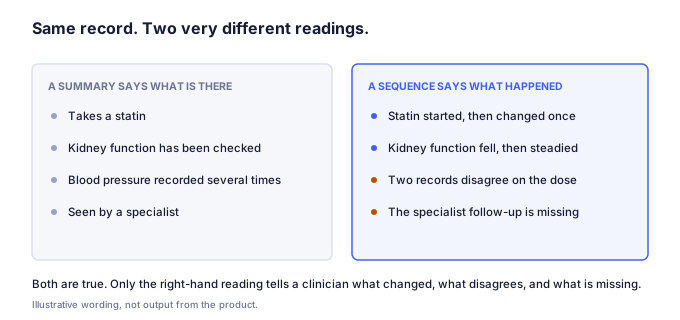
In clinical AI this distinction matters more than almost anywhere else, because an answer can sound convincing while missing a critical event or drawing on information from the wrong point in the patient's history. We have written before about why a fluent, complete-looking answer is the most dangerous kind to get wrong.
Why time changes the meaning of a clinical fact
Medical information is chronological by nature.
A laboratory result from several years ago is useful history. It does not describe the patient today. A medication that was stopped should not be shown as current. A report uploaded this morning may describe an investigation done months ago.
The clearest way to see the problem is to look at the dates on a single blood test.
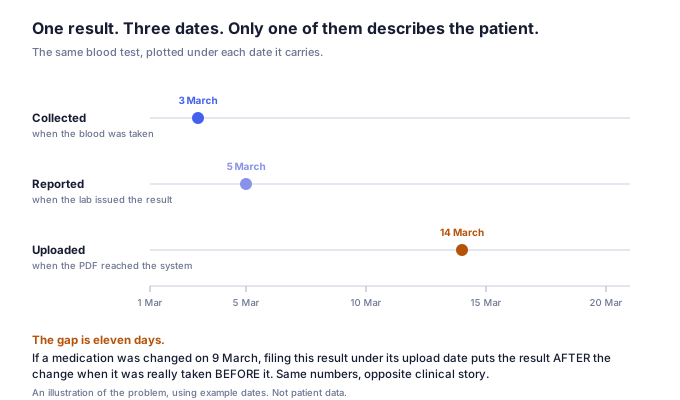
One result carries at least three dates. The blood was collected on one day. The laboratory reported it on another. The PDF was uploaded to the clinical system on a third. In the example above those dates are eleven days apart, which is ordinary rather than unusual.
Only the collection date describes the patient. And the consequence of choosing wrongly is not a cosmetic error. If a medication was changed on 9 March, a system that files this result under its upload date places the result after the change, when the blood was actually taken six days before it. Same numbers, opposite clinical story.
This is why reliable longitudinal intelligence has to preserve the original clinical dates, the source of each fact, and any uncertainty attached to it. It also has to accept that records are not always complete or consistent. Two documents may describe different regimens. An investigation may be referenced without its result. A later report may amend an earlier one.
What a system should do when records disagree
Rather than silently choosing a version, a responsible system should preserve the difference and make it visible.
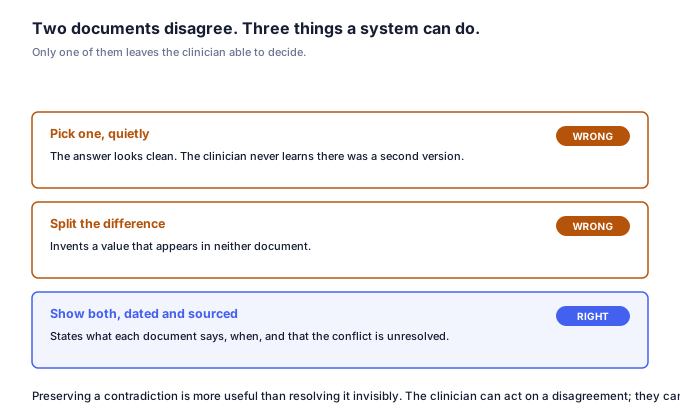
The third option looks less impressive in a demonstration. It is the only one that leaves the clinician able to act. A disagreement a clinician can see is a prompt to check. A disagreement resolved invisibly is a decision the machine made on their behalf, without telling them.
Why summarising a record is not enough
Large language models can search, interpret and condense a great deal of clinical text. But summarisation and longitudinal reasoning are not the same task.
A summary tells a doctor what appears in a set of records. Longitudinal reasoning has to establish what happened, when, what changed, and how well the sources support that reading. Four things have to go right.
The relevant information must be found. A clinically significant event may sit in an older document rather than the latest consultation note.
It must actually reach the reasoning step. Finding a document in a search index does not establish that its contents were read before the answer was written.
The relationships between events must survive. Years of history flattened into one narrative loses exactly the structure that made it useful.
Uncertainty must be communicated. When the records are incomplete, the correct answer is often to explain what is known and what cannot be established.
These are research problems, not interface problems. A 2025 study in npj Digital Medicine — TIMER: Temporal Instruction Modeling and Evaluation for Longitudinal Clinical Records — built the first time-aware benchmark for reasoning over multi-visit electronic health records, and found that tuning a model on the temporal structure of the record improved performance by 7.3 percent on human-generated benchmarks and 9.2 percent on their own temporal benchmark. The principle it reinforces is the one above: what matters is attention to the structure of time in the record, not the quantity of text a model can hold.
How we are building longitudinal patient intelligence
At Respocare Connect AI our development programme is called Northstar. It already has an established foundation for patient-scoped retrieval, clinical tools, reasoning and source-linked responses. We are building on that foundation rather than creating another chatbot.
Our current engineering focus, Phase 2: Living Patient Intelligence, is directed at how reliably the system reconstructs, compares and communicates patient information across time. It has five components.
1. Keeping the original record authoritative. The patient's own record stays the source of clinical truth. The design does not depend on a second, competing database that independently declares what is true about a patient. The system derives clinical context from authorised source documents while keeping what it needs to trace a finding back to the document it came from. A clinician should be able to see the basis of an important statement rather than trust an unexplained summary.
2. Reconstructing events in the correct order. A medical history is not a list of uploaded files. The architecture focuses on the clinical events inside those files, separating when an event happened from when it was documented, reported or uploaded, wherever that distinction can be established. That is what makes the useful questions answerable: what changed since the last review, how measurements have moved, which medication changes are documented and when, and which follow-ups remain unresolved. The aim is not a timeline that looks convincing. It is one that can be checked against the original sources.
3. Preserving evidence, contradictions and uncertainty. Documentation is rarely perfect — incomplete, duplicated, amended, inconsistent. A system that resolves every discrepancy automatically is manufacturing certainty. The work therefore emphasises source provenance, evidence availability, conflicting records and explicit missingness. If a finding cannot be established from the authorised evidence, it should not be presented as an established fact.
4. Supporting natural, context-aware investigation. Clinical questions rarely stop at one. A doctor may ask what changed in a medication history, then which changes came earlier, then for a comparison with the latest results. The assistant has to understand how those questions relate while recognising when it must go back to the record rather than reuse what is already on screen.
5. Verifying it before claiming it works. Building the behaviour is one problem; proving it is another. We have established a synthetic longitudinal evaluation programme using a fictional patient, Richard Collins, whose reference dataset holds 150 PDFs spanning approximately ten years of invented clinical history. The benchmark includes reasoning cases and multi-turn conversations designed to test retrieval, chronology, interpretation of change and appropriate uncertainty.
The presence of those test records does not by itself prove successful ingestion, clinical accuracy or completed end-to-end certification. That is exactly why the process separates implementation, technical testing, independent clinical evaluation and release decisions. We want to measure the quality of the clinical work, not how intelligent the text sounds.
Five questions to ask about dates and time
If you are assessing a clinical AI product, these five questions separate a system that reasons across time from one that reads the most recent file. None of them requires a technical background. They sit underneath the five general questions for any clinical AI vendor, which test grounding, safety facts, deferral and authorship.
- Which date do you use? Ask whether the system distinguishes collection, report and upload dates — and what it does when only the upload date exists.
- Show me the source. For any statement about the past, can you open the document it came from, with its date?
- What happens when two records disagree? Ask them to demonstrate it on a record that contains a real conflict, not a clean one.
- How do you know the document was read? Appearing in a search result is not the same as being used to write the answer.
- What does it say when it does not know? Ask for the wording. A system that has no such wording has not been built for this.
A vendor whose product does this well will enjoy question three. It is the one that is easy to pass in a demonstration and hard to pass on a real record.
What this could look like in practice
Imagine a clinician reviewing a patient with several years of records. They ask: what has changed in this patient's documented history since the previous review?
A capable assistant should investigate the authorised records, identify the relevant dated events, compare what is available, and prepare a short, source-linked answer. Where a medication change is documented, it should say when. Where comparable measurements exist, it should give the values and the clinical dates. Where records conflict, it should preserve the conflict. Where an important record is missing, it should say so.
The clinician can then ask a follow-up, inspect the evidence, or request a narrower comparison.
That is the experience we are working towards. It is an illustration of product direction, not a claim that every capability described has completed clinical validation or been released.
From longitudinal intelligence to more useful clinical AI
Reliable patient context opens the door to richer work. The Northstar roadmap includes three complementary directions.
Patient-specific clinical discovery would help clinicians identify questions worth investigating based on evidence actually present in the authorised record, rather than generic prompts that assume facts about the patient.
Adaptive clinical responses would let information be communicated in the form best suited to the task: a concise explanation, a cited table, a validated chart, a longitudinal timeline.
Clinical Intelligence in Motion would make the system's verified workflow activity understandable during longer investigations, without pretending to reveal private reasoning or showing invented progress.
Each requires its own implementation and evaluation milestones. Together they express one ambition: clinical AI that investigates information intelligently and communicates what it finds in a form that genuinely helps.
The clinician must remain in control
Greater capability should not mean transferring clinical authority to a machine.
Longitudinal reasoning can support a doctor's understanding of the record, but interpretation, judgement and patient-care decisions remain with appropriately qualified professionals. The system must operate within authorised patient access, preserve uncertainty and support human review.
Trustworthy medical AI is not defined by how confidently it answers. It is defined by how reliably it uses evidence, recognises its limits, and supports the clinician's work.
The future of medical AI is more than a longer memory
There is a temptation to think the next generation of clinical AI arrives simply by giving models larger context windows and more documents. But holding more information does not guarantee that the right evidence is selected, read correctly, or placed in its proper clinical context.
The harder engineering problem is a system that can tell historical from current, investigate change, preserve contradiction, and produce conclusions that stay faithful to the underlying records. That is the work behind longitudinal patient intelligence.
We are developing it through evidence-focused engineering, reproducible testing and a commitment to clinician authority. The future of clinical AI should be measured not by how much information it can repeat, but by how responsibly it helps clinicians understand the information that matters.
The AI drafts, the record verifies, the clinician decides — and longitudinal reasoning is how the record learns to verify across time.
Respocare Connect AI is a clinical assistant and documentation platform. It is not a medical device, it is not diagnostic, and every output requires independent clinician review. Richard Collins is a fictional, synthetic patient created for evaluation; no real patient data appears in this article. Built by Respocare (PTY) Ltd, a licensed South African healthcare practice operating since 2018.
Reference
Cui H, Unell A, Chen B, Fries JA, Alsentzer E, Koyejo S, Shah N. TIMER: Temporal Instruction Modeling and Evaluation for Longitudinal Clinical Records. npj Digital Medicine. 2025. doi:10.1038/s41746-025-01965-9 (preprint: arXiv:2503.04176)
Related reading
- Northstar — the engineering programme this work sits inside.
- Why a cited answer is not automatically a safe answer — the failure mode this article is written against.
- Reasoning across the whole record — the short version of the argument.
- Should clinical AI stop at the scribe? — the published evidence on earning each step beyond documentation.
Keep reading
Built by Respocare (PTY) Ltd — a licensed South African healthcare practice operating since 2018.